

Contribution margin calculator
Do I make money on each order after ads? CM1, CM2 and CM3 per order, after product cost, shipping, RTO and ads.
Free answer on screenAbout a minuteYour numbers stay in your browser
Services
All servicesMore
IndustriesResultsHow we workPricingFree toolsAboutContactDo I make money on each order after ads? CM1, CM2 and CM3 per order, after product cost, shipping, RTO and ads.
Do I make money on each order after ads?
Full breakdown
Three fixes for your numbers
See the full breakdownThe numbers behind your answer and three fixes, also sent to your WhatsApp.
Are you losing money here? A senior marketer will find where, in 48 hours, free.
Get the free growth auditYour numbers look healthy. Book 30 minutes and we will show where to grow next.
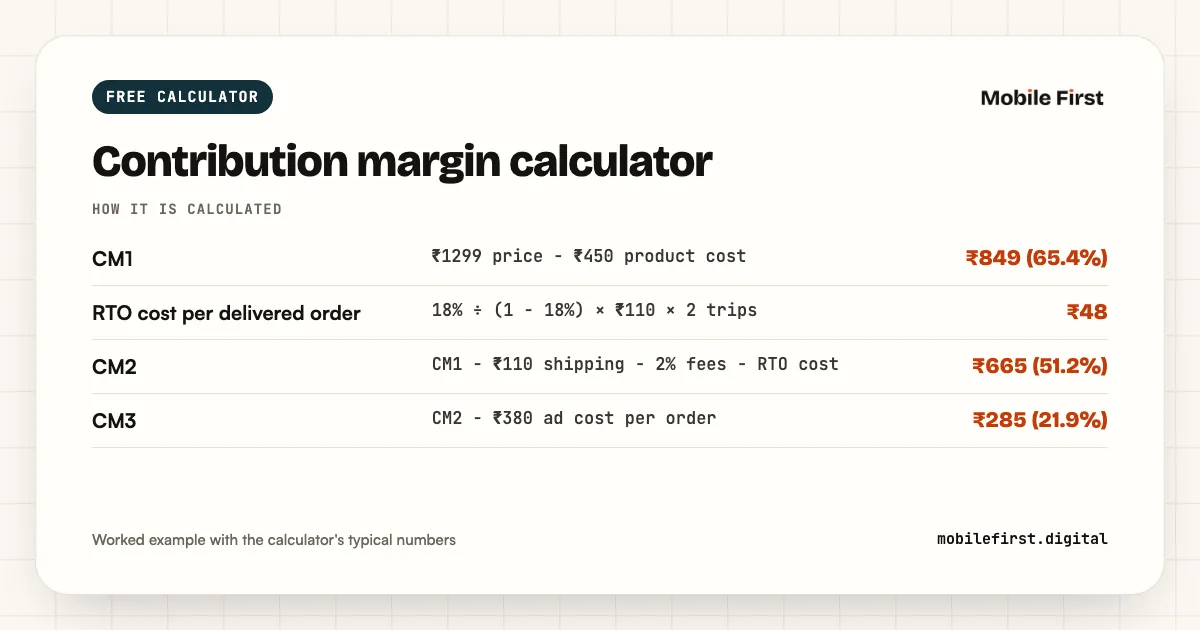
Book a callWorked through with the typical numbers already in the calculator.
What you get
| Step | Formula | Result |
|---|---|---|
| CM1 | ₹1299 price − ₹450 product cost | ₹849 (65.4%) |
| RTO cost per delivered order | 18% ÷ (1 − 18%) × ₹110 × 2 trips | ₹48 |
| CM2 | CM1 − ₹110 shipping − 2% fees − RTO cost | ₹665 (51.2%) |
| CM3 | CM2 − ₹380 ad cost per order | ₹285 (21.9%) |
These are the targets we use in audits, not a law. Categories with high repeat buying can accept a lower CM3 on the first order.
| Our working targets for D2C brands | |
|---|---|
| CM1, after product cost | 55 to 70% of price |
| CM2, after shipping, fees and RTO | 35 to 50% of price |
| CM3, after ads | Positive, ideally 10%+ of price |
This page was updated in October 2026 and reviewed by our senior marketing team.
We see these in most accounts we audit.
Boxes, inserts and labels are part of the cost of every order.
Payment gateway and COD fees come off every order, and they add up across thousands of orders.
An RTO order pays shipping out and back and earns nothing.
Use the price after GST, because the tax is not money you keep.
These are the four levers we pull first, and the service behind each one.
Lever 1
Bundles and a free-shipping threshold spread shipping over more revenue.
Fixed by website conversionLever 2
We use prepaid offers and COD confirmation where RTO is highest.
Fixed by retention marketingLever 3
We test creative weekly and move budgets to campaigns with a positive CM3.
Fixed by performance marketingLever 4
We check discount depth against CM2, product by product.
Fixed by E-commerce and D2C consultingCM1 is your selling price minus the product cost.
CM2 is CM1 minus shipping, payment fees and the cost of RTO, for each delivered order.
CM3 is CM2 minus the ad cost of winning the order. If it is negative, every order loses money.
CM1 is price minus product cost. CM2 also takes off shipping, payment fees and RTO. CM3 also takes off the ad cost to win the order. CM3 is what you keep.
An undelivered order pays forward and return shipping, and its cost has to be carried by the orders that were delivered.
On a one-time purchase, yes, it should. If customers reorder often, a small first-order loss can be fine, as long as the CAC payback tool says it pays back within six months.
You need your selling price after discount, product cost, shipping and packing, payment fees, RTO rate and ad cost per order.
In our audits we aim for 35 to 50% of price, but it depends on your category and how often customers reorder.
Lift order value with bundles, cut RTO, lower the ad cost per order and check discount depth product by product.
Use the price after GST and discounts, which is the money you actually keep from each order.
Five questions, no email needed. You get an honest answer on screen.
Great fit
Book 30 minutes and we will read your accounts before the call.
Book a callGood fit
You keep the findings either way.
Book a callNot yet
Our free tools will show you where your money goes today. When you cross ₹5 lakh a month, come back and we will read your accounts. If you would like advice before then, we are happy to talk.
Tell us about your brand. We read your accounts before the call, so it is about your numbers.