

Google ads for e-commerce brands, judged on profit
Search, Shopping, Performance Max and YouTube, bid by product margin.
Who it is for: E-commerce brands with searchable demand or a product catalogue.
Services
All servicesMore
IndustriesResultsHow we workPricingFree toolsAboutContactSearch, Shopping, Performance Max and YouTube, bid by product margin.
Who it is for: E-commerce brands with searchable demand or a product catalogue.
Each one used where it earns.
These ads show for what people type, from your brand name to category terms.
Product ads with image and price, built from your Merchant Center feed.
This is Google's automated campaign across Search, Shopping, YouTube, Display and Gmail.
These video and image ads create demand before people search.
Step by step, in the order we do it.
We set up Google Ads conversions with enhanced conversions, then check that Google Ads, GA4 and Shopify count roughly the same orders.
We fix feed errors and disapprovals, rewrite product titles with the words people search, and add custom labels for margin and bestsellers.
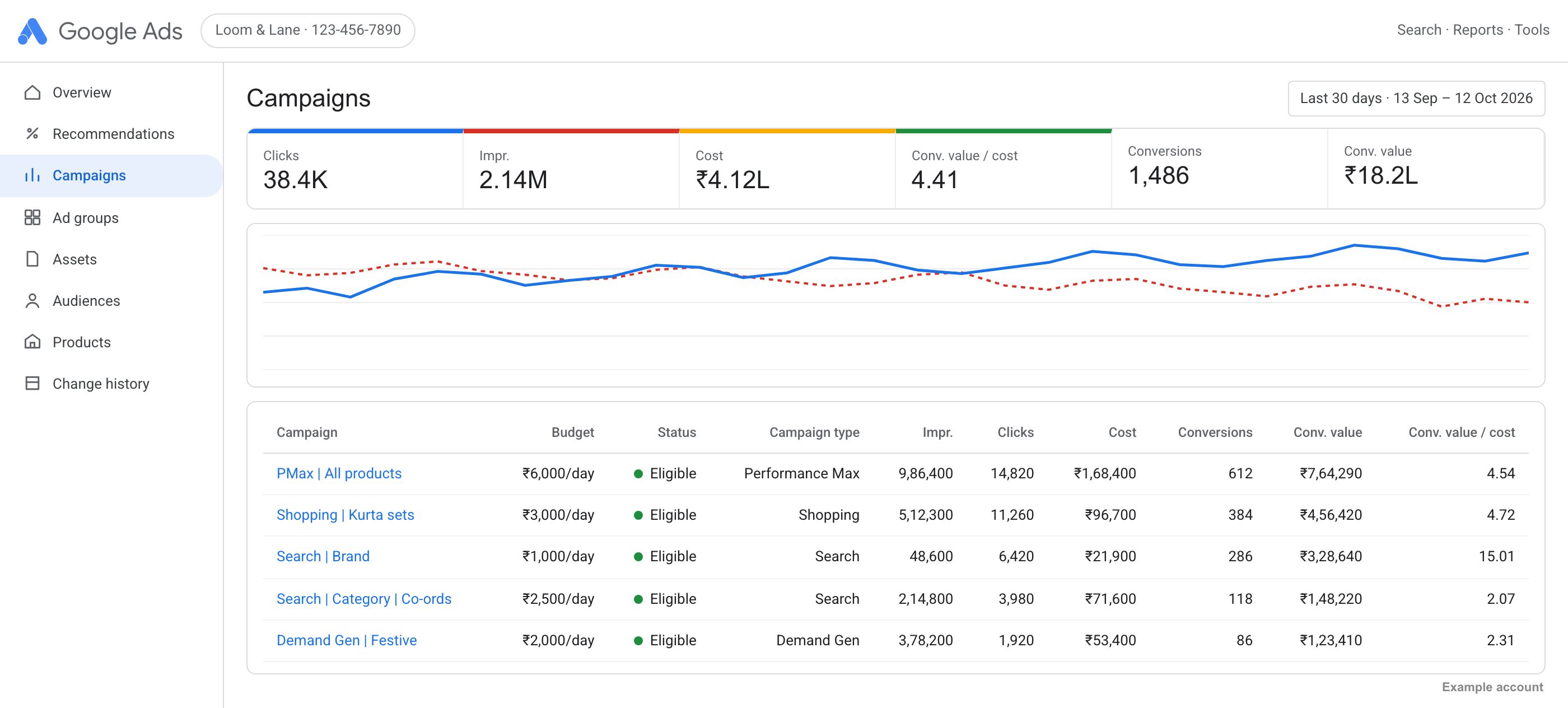
Brand search runs in its own campaign, so it cannot hide weak results elsewhere. Performance Max gets brand exclusions, so it does not claim sales from people already searching your name.
Category and product terms run on exact and phrase match. We read the search terms report every week and add negative keywords for searches that do not buy.
Shopping and Performance Max campaigns are split by margin label, so high-margin products are not starved by cheap bestsellers.
Once search and shopping are profitable, we add YouTube and Demand Gen to create demand rather than only catch it.
Checked in October 2026, with the source for each.
Performance Max lets you exclude your own brand terms, so it does not take credit for people already searching your name.
Source: Google Ads Help
Enhanced conversions send hashed first-party data, such as the buyer's email, to recover conversions that cookies miss.
Source: Google Ads Help
Run by a senior marketer with five accounts at most.
Most Google ROAS comes from people already searching your name. Without splitting it out, growth looks bigger than it is.
Shopping and Performance Max are only as good as the feed. Missing attributes mean missed searches.
Low-margin products eat budget that high-margin products could use better.
You see ROAS and contribution margin side by side, every week.
Weekly
ROAS and margin by channel, what changed, what is next.
Monthly
It compares results against your targets and sets next month's roadmap.
Quarterly
Realistic numbers from your own data, checked against what actually happened.
How Google ads usually starts, from the free audit to the first quarterly plan.
Week 1
Weeks 2 to 4
Month 2
Month 3
The same operating rhythm on every account, from the first week.
Owns your account and your targets, with five ad accounts at most.
ROAS next to contribution margin, what changed and what happens next.
Every channel in one view, so you never wait for the weekly call.
Results against the targets agreed in writing, and next month's plan.
Projections built from your own numbers, checked against what happened.
Day-to-day questions answered by the person who runs your account.
| Typical agency | In-house team | Your growth teamMobile First | |
|---|---|---|---|
| Budget decisions | At the monthly review, on platform ROAS | When someone gets time to check | Every week, on margin after returns and RTO |
| Search terms | Reviewed when results drop | Rarely reviewed | Read every week, with negative keywords added |
| Tracking | Google tag installed at onboarding | Set up once by a freelancer | Enhanced conversions and GA4, checked against your store's orders |
| Who runs it | A junior across 15 or more accounts | One person across every channel | A senior marketer with five accounts at most |
Each industry page covers the season, channels and checks for that category.
It can be, if the product feed is clean and conversion tracking is accurate. On its own it tends to lean on brand searches and retargeting. We split brand from non-brand, group products by margin and compare it against Shopping so you can see where new customers actually come from.
Shopping ads show your product image, price and store name when someone searches for a product. Google builds them from your Merchant Center feed, so the quality of titles, images and attributes decides how often you appear. Fixing the feed is usually the first win.
Usually yes, but report it separately. Brand search is cheap and protects you from competitors bidding on your name. It should not be counted as growth, because most of those people were already looking for you.
Search and Shopping can show results within two to three weeks. Performance Max needs about four to six weeks of data to settle. We judge it on profit after that learning period, not on the first week.
We run Search, Shopping, Performance Max, Demand Gen and YouTube campaigns.
Yes. Feed titles, images and attributes decide how often your Shopping ads appear, so we fix them first.
Yes, through Demand Gen and video campaigns, scored on sales as well as reach.
We review search terms every week, add negative keywords and move budget to terms that bring profitable orders.
No. We set the budget from your break-even ROAS after the audit.
We report it separately, because most people searching your brand name were already looking for you.
Five questions, no email needed. You get an honest answer on screen.
Great fit
Book 30 minutes and we will read your accounts before the call.
Book a callGood fit
You keep the findings either way.
Book a callNot yet
Our free tools will show you where your money goes today. When you cross ₹5 lakh a month, come back and we will read your accounts. If you would like advice before then, we are happy to talk.
Tell us about your brand. We read your accounts before the call, so it is about your numbers.