Flipkart ads agency for D2C brands in India: Flipkart ads that pay after the returns come back

Your Flipkart expert works out the ROI each product needs once returns and fees are paid, then bids to clear it every day. Each week you see Flipkart’s ROI next to the money that actually reaches your bank.

  • One Flipkart expert on your account, 3+ years on Flipkart
  • Bids checked every day against returns, stock and dispatch
  • Flipkart on the same weekly profit report as your website and Amazon
Flipkart campaignsWeek 43
CampaignStatusROIMargin after returns
Category searchKurtas, exact termsActiveBid cut4.20₹52,400+₹40,000 next week
Smart ROI, proven kurtasTarget set after returnsActiveBid cut4.60₹21,800
Your brand nameRun and judged apartActiveBid cut8.90₹9,600
Rival product pagesROI 3.0x, needs 3.3xBid cut, budget movedActiveBid cut3.00−₹8,700
4 campaignsFlipkart ROI 4.39
In the bank this week₹75,100Margin after returns, all Flipkart campaigns

Brands our marketers have worked with

  • Flipkart
  • Cleartrip
  • Shopsy
  • Flipkart Reset
  • Sri Sri Tattva
  • Killer
  • Showoffff
  • Epik
  • Gir Organic
  • Entisi
  • Minskinn
  • Prakrat

Why Flipkart ads stop paying

01

The ROI is counted before the returns

Flipkart credits the ad the moment an order is placed. When the parcel comes back a week later, the ad keeps the credit and you pay shipping both ways. A kurta at 4x ROI that comes back one time in four can still lose money.

02

One target ROI for the whole account

Every product has its own price, cost and return rate, so each needs a different ROI to break even. One target for all of them means some lose money quietly while others never get the budget they could use.

03

Smart ROI is left to run on its own

Set the target too high and it stops spending. Set it too low and it buys orders at a loss. Nobody checks it against what each product earns after returns.

04

Sale days spend the most and earn the least

Bids go up on Big Billion Days, when every click costs more, on products that never built rank before. The orders look great on the day. The returns arrive over the next three weeks.

Find out which of your Flipkart products lose money on ads.

Your Flipkart expert reads your account and sends the report in 48 hours.

Get my free growth audit

What ROI does each product need?

Fashion has paid no commission on Flipkart since July 2026, so it is tempting to think every order is cheaper now. Returns still decide the margin. Here is one ₹1,299 kurta, the same one on our Amazon page, sold on Flipkart.

  1. 1
    GST on the sale

    Kurtas up to ₹2,500 carry 5% GST, so ₹62 of the price was never yours.

  2. 2
    Flipkart’s fees

    Commission is ₹0 on fashion. The fixed fee and collection fee (about ₹76 at this price) and shipping for a parcel under 500 g (about ₹55) still apply.

  3. 3
    Product cost and packing

    What the kurta cost you to make, pack and hand over for pickup.

  4. 4
    Returns

    Flipkart fashion sellers see 20 to 35% of orders come back, so we use one in four. A returned kurta keeps none of its ₹586 and costs about ₹165 more in shipping both ways and repacking. Spread over every order, that is ₹188.

  5. 5
    The ROI it needs

    Price divided by what is left. Below this ROI, every order the ads bring in loses money.

One kurta, one order

TakenLeft
The buyer pays₹1,299
GST on the sale, 5%−₹62₹1,237
Commission, fashion₹0₹1,237
Fixed and collection fees−₹76₹1,161
Shipping, under 500 g−₹55₹1,106
Product cost and packing−₹520₹586
Returns, 1 in 4, per order−₹188₹398
ROI this product needs3.3x
  • At 3.0x ROI, the ad costs ₹433−₹35 an order
  • At 4.0x ROI, the ad costs ₹325+₹73 an order

Flipkart also adds 18% GST on its fees and on ad spend, and holds back 0.5% TCS and 0.1% TDS from payouts. GST-registered sellers claim these back, so we show them in your report but leave them out of this number. Fees change with your seller tier and shipping zone, so your expert uses your own rate card.

The panel shows this kurta at 3.0x ROI, and most teams would leave it running. It loses ₹35 on every order the ads bring in. A kurta with half the returns would make money at the same ROI. Your expert works out this number for every product, from its own return rate.

The two Flipkart screens we read every day

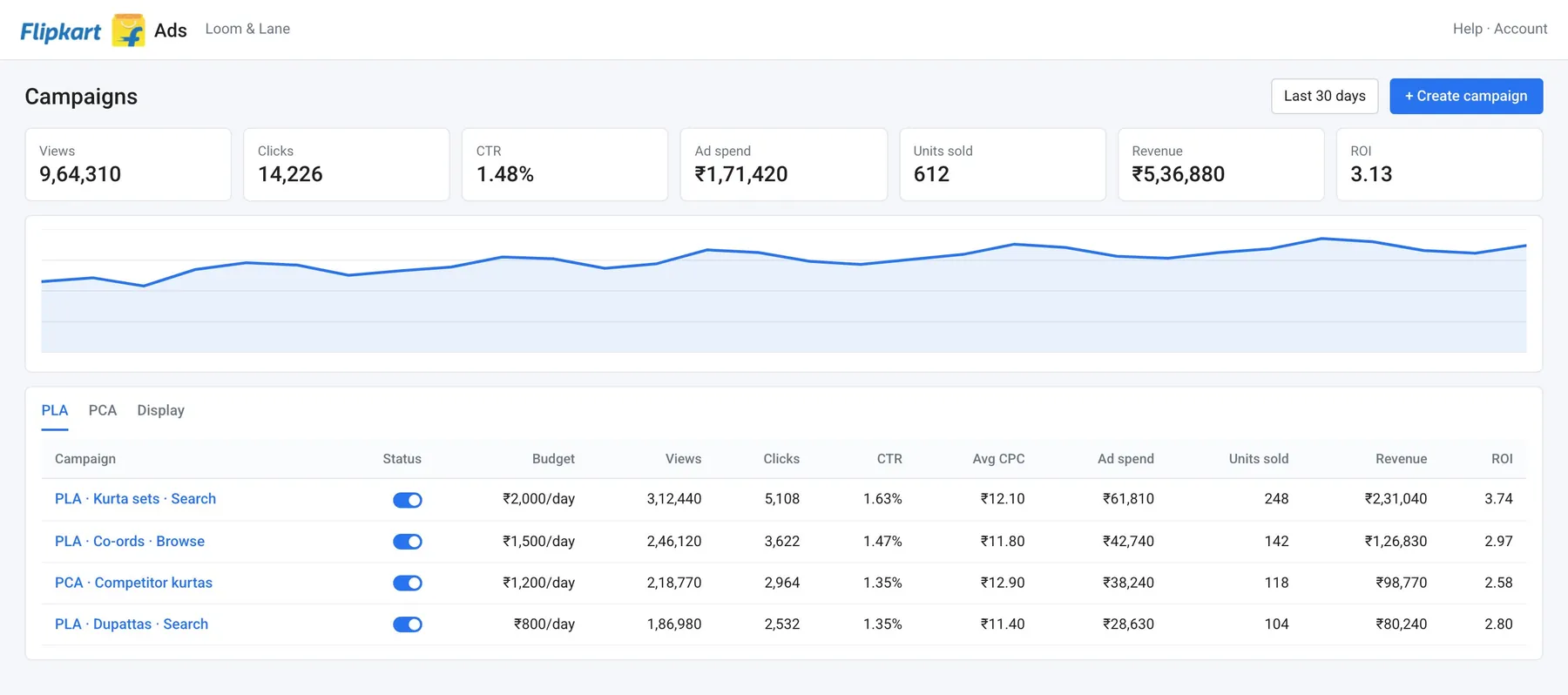
Seller Hub shows what was sold and what came back. Flipkart Ads shows what the ads claim. We read them side by side.
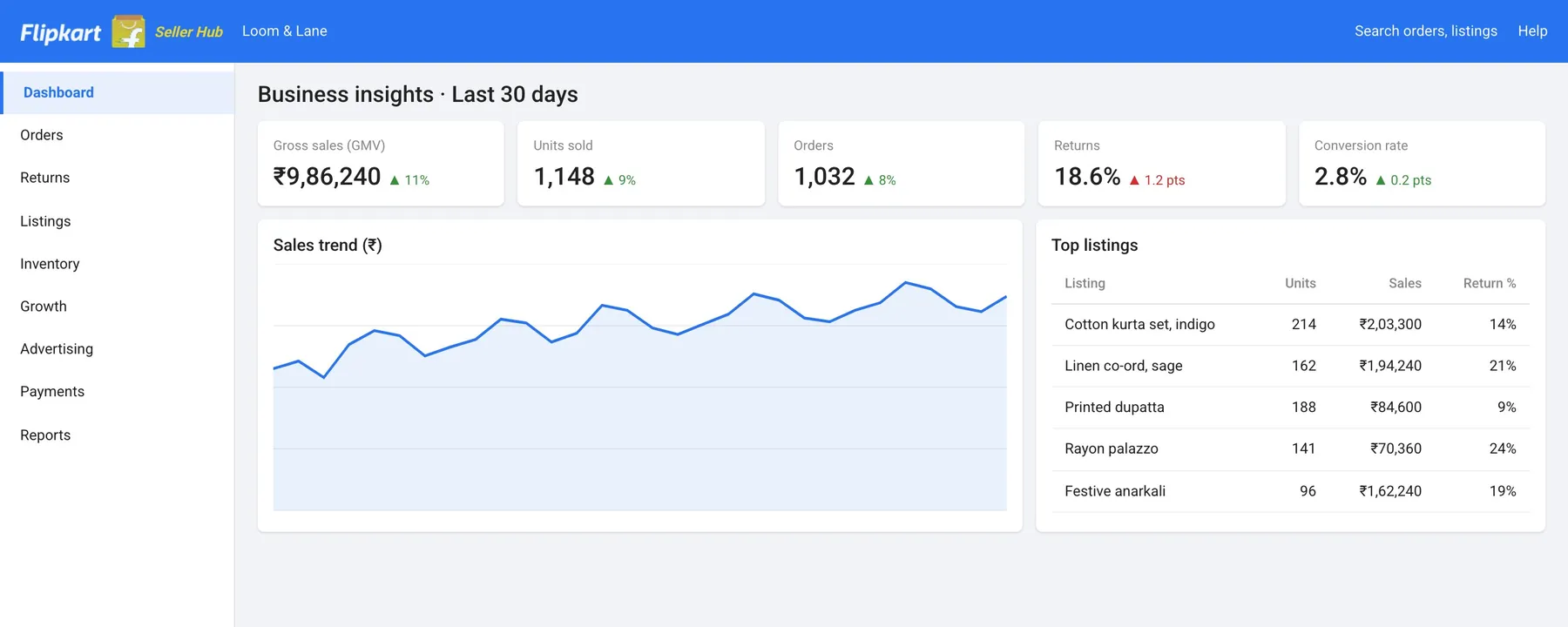
seller.flipkart.com
Flipkart Seller Hub business insights with GMV, units, returns and conversion

What we read here. GMV is before returns and commission. We track return rate by listing, because a best-seller with 24% returns can lose money. Open full size
Get the ROI every one of your Flipkart products needs.

What Flipkart’s ROI counts, and what it leaves out

The ROI in your Flipkart Ads panel is ad revenue divided by ad spend. It is a useful number. It just isn’t the money you keep, and three things sit between the two.

One month, two views

Flipkart showsDirect and kept
Orders from ads1,000615
Ad revenue₹12,99,000₹7,98,900
Ad spend₹3,16,800₹3,16,800
ROI4.1x2.5x

180 orders were other products bought after the click. 205 of the rest were returned or cancelled. Flipkart still counts all of them.

Returns and cancellations

The panel counts the order when it is placed. Orders that are cancelled, returned or refused at the door stay in the ad revenue. We match your Seller Hub returns to each product, so you see ROI after returns too.

Sales of your other products

Flipkart splits ad sales into direct (the product in the ad) and indirect (another product of yours bought after the click). Indirect sales are real, but many would have happened anyway. We report them apart and bid on direct.

Orders you’d have got anyway

Ads on your brand name, or on products already at the top of search, bring orders that would have come free. Brand searches run in their own campaigns, and we watch whether total Flipkart sales grow with spend.

CPC or Smart ROI: which Flipkart campaign, and when

Flipkart Ads runs campaigns two ways. Each suits a different product at a different stage, and most accounts need both.

CPC campaigns

How it worksYou set the bid for each keyword or placement and pay per click.

Best forNew products with little sales history, your brand name, rival product pages and sale-day pushes, where you want to choose exactly where you show.

What goes wrongBids get set once and forgotten, and keep paying for clicks that stopped selling.

How we run itEvery bid is capped at what the product can afford, search terms are checked weekly, and terms that don’t sell become negatives.

Smart ROI campaigns

How it worksYou set a target ROI and a total budget. Flipkart picks the bids and placements.

Best forProven products with steady weekly orders, where Flipkart has enough data to learn from.

What goes wrongA target set too high stops spending. Too low, and it wins orders at a loss. It judges itself on Flipkart’s ROI, before returns.

How we run itThe target comes from the product’s ROI after returns, with room to spare, and is checked against the returns report every week.

A product moves from CPC to Smart ROI once it sells steadily, and moves back if returns rise or Smart ROI stops spending.

What changed on Flipkart in 2026, and what we changed for you

Fees, penalties and the help Flipkart gives sellers all moved this year. These are the changes that matter for a D2C brand, newest first.

Updated November 2026

  1. Oct 2026

    Big Billion Days, with Minutes in the mix

    What it means for your sales

    The 13th Big Billion Days started on 9 October, with early access on the 8th. Flipkart Minutes, now in about 1,000 dark stores, took about three and a half times its usual orders.

    What we do

    Sale results are judged only after returns close. Small, low-priced products are checked for Minutes stock before the next sale.

  2. Aug 2026

    Saarthi: free AI tools and agency help

    What it means for your sales

    Flipkart Ads launched a free AI campaign tool for every seller, with alerts, custom rules and ad scheduling, plus free help from certified agency partners.

    What we do

    Its alerts and scheduling are switched on for you. The section below covers what it does and doesn’t see.

  3. Aug 2026

    Penalties for late dispatch

    What it means for your sales

    ₹30 for missing the dispatch date, ₹60 if the order is cancelled after three missed dates, and ₹90 if it is late and then cancelled. Flat amounts, whatever the order value.

    What we do

    Ads pause on products your warehouse can’t ship on time, because a cancelled order now wastes the click and costs a penalty.

  4. Jul 2026

    Zero commission on all fashion

    What it means for your sales

    Clothing, footwear and fashion accessories pay no commission at any price. Fixed fees, shipping and returns still apply.

    What we do

    Bid limits raised product by product on fashion, only where the return rate allows.

  5. Nov 2025

    Zero commission under ₹1,000

    What it means for your sales

    Products under ₹1,000 stopped paying commission, and return fees came down by ₹35. Shopsy went commission-free on every listing.

    What we do

    Lower-priced products got room for ads. On a ₹399 product, shipping and returns still take most of it, so we check before raising bids.

Sources: Flipkart: Saarthi; Flipkart: Big Billion Days 2026; Zero commission on fashion; Dispatch penalties; Zero commission under ₹1,000

The Flipkart ads we run, and the job each one does

Each format shows in a different place and does a different job. We start where buyers are already searching and add the rest when the numbers support it.

Product Listing Ads

Where it showsSearch results, category pages, the homepage and product pages, looking like a normal listing with an Ad tag

When we use itFrom day one, split into brand, category and competitor campaigns. Usually most of the budget.

Judged onROI after returns, against what each product needs

Product Contextual Ads

Where it showsOn the pages of related and competing products, while shoppers compare

When we use itOnly on rival products your price, rating and delivery beat side by side. On a rival that wins the comparison, you pay for the click and the buyer stays with them.

Judged onOrders from comparison shoppers, and which rival pages pay

Brand ads and display

Where it showsBanners at the top of search and category pages linking to your brand store, and on the homepage

When we use itFor launches, sale events and categories where shoppers search by type rather than brand, once listing ads already pay.

Judged onNew buyers to your brand and lift in brand searches

Video ads

Where it showsIn the feed and on product pages in the Flipkart app

When we use itFor products a buyer needs to see in use: fit, fabric, a gadget at work. Your team or creators from our network make the video from our brief.

Judged onProduct page visits and orders, with view-only sales reported apart

Flipkart Minutes

Where it showsMinutes search and category pages, when your products are stocked in its dark stores

When we use itFor small, low-priced, everyday products like basics, beauty refills and chargers. Run from your main Flipkart Ads account, next to your Blinkit and Zepto plan.

Judged onOrders by city, and margin after fees on small baskets

Shopsy

Where it showsFlipkart’s value app, where buyers shop by price and most pay cash on delivery

When we use itFor products under about ₹500 that still make money with no commission and a higher return rate. We test it on a few products first.

Judged onDelivered orders and margin, with refused parcels counted

We don’t make banners, videos or brand store images. Your team, your designer or creators from our network make them, from a brief your expert writes using your Flipkart search and return data.

Five things that decide whether a Flipkart ad pays

A Flipkart ad brings the buyer to your listing. The order still has to ship on time, arrive and stay. If any of that fails, the click is paid for and the money is gone. Your Flipkart expert checks these five every day.

1Returns by product and size

We checkReturn rate and the reasons buyers give, by product and size.

When it failsA best-seller with a high return rate loses money on every order the ads bring.

Bids come down the same week, and your team gets the top return reasons so sizing, photos or descriptions can change.

2Stock and dispatch

We checkStock by product and size, and whether orders ship by the dispatch date.

When it failsAds keep selling what can’t ship, orders get cancelled, and Flipkart charges up to ₹90 an order.

We pause or lower bids the same day and tell your team what to restock.

3Flipkart Assured and delivery date

We checkWhether a product carries the Assured badge, and the delivery date buyers see.

When it failsBuyers pick the product that arrives sooner, so each click sells less.

We tell you which products would earn more stored in Flipkart’s warehouses. The setup stays with your team.

4Ratings and reviews

We checkStar rating, review count and what recent reviews complain about.

When it failsBuyers pick the 4.2-star kurta over your 3.7 however good the ad.

Each month we send the top complaints, and bids stay low on products under 3.8 stars until they improve.

5The listing

We checkTitle, images, specifications, and whether the words buyers search are on the page.

When it failsThe product shows for the wrong searches and doesn’t sell on the right ones.

We brief the words and the image order; your team makes the changes; we check before they go live.

We don’t run catalogue uploads or account setup. We fix what holds your ads back, and tell you when the problem sits outside the ads.

See where your Flipkart orders leak before you raise bids.

How we set up your Flipkart ads

In this order, from the first week.

  1. 1
    The ROI each product needs

    Your cost, Flipkart’s fees and each product’s return rate turn into the ROI it must clear. That caps every bid.

  2. 2
    Ads off where they lose

    Products that come back too often, are out of stock, ship late or sit under 3.8 stars are paused or bid down until fixed.

  3. 3
    Brand, category and competitor kept apart

    Separate campaigns for your brand name, category searches and rival product pages, each with its own budget and goal.

  4. 4
    Search terms found, then scaled

    Broad campaigns find what buyers type. Terms that sell get their own bids, and terms that don’t are added as negatives every week.

  5. 5
    Proven products moved to Smart ROI

    Once a product sells steadily, it moves to Smart ROI with a target set from its ROI after returns.

  6. 6
    Placements bid on their own

    Search, product pages and the homepage sell very differently, so each gets its own bid.

  7. 7
    Ads scheduled by the hour

    Flipkart’s new tools let us run ads by hour. Spend comes down in the hours your products don’t sell and goes up where they do.

What we need from you

  • Access to Seller Hub and your Flipkart Ads account, with us added as a user. The accounts stay in your name.
  • Product cost for each product, so we can work out the ROI it needs
  • Your returns and cancellations reports
  • Stock plans and dispatch capacity for sale events
  • Someone in your team who can update listings and images from our brief

Big Billion Days, planned six weeks ahead and judged after returns

Rank on sale day is earned in the weeks before it. On Flipkart the result also takes weeks to settle, because returns keep arriving after the sale ends.

  1. 1
    Six weeks out

    Pick the products to push from margin, stock and return rate, and agree the sale price with you. A lower price means each order keeps less, so we redo the ROI each product needs at the sale price.

  2. 2
    Four weeks out

    Raise ads on those products to build rank and reviews while clicks are cheaper. Check stock and dispatch capacity too, since late dispatch now carries a penalty.

  3. 3
    Sale days

    Bids and budgets checked several times a day. Money moves to what is selling, and ads pause the hour a product runs out or dispatch falls behind.

  4. 4
    The three weeks after

    Spend comes down in steps so rank holds. When returns close, you get the real result: what the sale earned after returns, fees and cancellations, and how many buyers were new.

The Flipkart sale calendar

JanRepublic Day saleFlipkart-wide deals
AugIndependence Day saleFlipkart-wide deals
Sept to OctBig Billion DaysThe biggest weeks of the year, from 9 October in 2026
Oct to NovDiwali salesGifting, home, fashion and electronics
Every monthValue salesShort sales that suit lower-priced products
Any monthYour own launchesPlanned like a sale

Dates move every year, so the plan starts from Flipkart’s announcement.

Plan your next Flipkart sale from your own numbers.

Flipkart now offers free ad help. Here is where we fit

In August 2026 Flipkart launched Saarthi, which gives every seller a free AI campaign tool and free help from certified agencies. Eligible sellers can also run ads now and pay from next month’s payout. Here is what each covers, and what it can’t.

Saarthi

What you getAn AI tool with alerts, product-level reports, custom rules and ad scheduling, plus hands-on help from a certified partner, at no cost to you.

What it coversYour Flipkart ads.

What to watchIt can’t see your product cost, your other marketplaces, your website or your bank.

Advertise now, pay later

What you getAds with no money upfront. The spend comes out of next month’s payout.

What it coversStarting ads when cash is tight.

What to watchA sale month that runs at a loss shows up later as a smaller payout. Spend still needs a limit set from margin.

Mobile First

What you getOne Flipkart expert working from your margins, returns and payout, as well as the ad panel.

What it coversFlipkart next to your website, Amazon and other channels on one weekly profit report, so budget goes where it earns most.

How we use the free toolsWe switch on Saarthi’s alerts and scheduling for you, and set a spend limit before any pay-later month.

If Flipkart is your only channel and you sell a few products that rarely come back, Saarthi may be enough, and the audit will say so. If you sell on several channels, or returns decide your margin, that is the work we do.

Find out whether free help is enough for your Flipkart account.

What AI can do for your Flipkart ads, and what still needs an expert

Flipkart already bids with AI through Smart ROI, and Saarthi added an AI assistant this year. Our experts use AI as a co-pilot, and deciding what your brand needs stays with a person.

Smart ROI

AI aloneChases the ROI target, counted before returns.

Your expertSets each target from the product’s ROI after returns.

Returns

AI aloneSees the order, not the parcel that comes back.

Your expertMatches returns to each product and cuts bids the same week.

Dispatch and stock

AI aloneKeeps selling what your warehouse can’t ship today.

Your expertPauses ads before late dispatch turns into penalties.

Sale events

AI aloneReacts after clicks have already got expensive.

Your expertBuilds rank in the weeks before, while clicks cost less.

What skills and connectors don’t change

Shopify and other connectors can put your orders, costs and ad spend side by side for AI to read, and most public ads skills say they read your data and report back. Our experts use AI as a co-pilot. Deciding what to do, and answering for it, stays with a person.

Someone still has to say yes

AI aloneMeta makes a person approve every action an AI tool takes on your account, and Google’s own connector can’t change a budget or a bid.

Your expertReads each change against your margin and stock before saying yes.

It can be wrong and sound sure

AI aloneAsked only to summarise a document placed in front of it, Claude Opus 5.5 still got 9.9% of summaries wrong and Gemini 3.1 Pro 10.4% (Vectara leaderboard).

Your expertChecks every number against your store and courier data.

It guesses what you leave out

AI aloneIt does nothing until someone writes the prompt and explains the goal, and it fills every gap with an assumption.

Your expertAlready knows your margins, stock and sale dates.

It runs out, and the bill grows

AI aloneMost Claude plans cap use every five hours and every week, ChatGPT Plus every three hours, and extra use, bigger models and agent servers cost more.

Your expertStays on your account through the sale weeks, with no usage cap.

The model changes under you

AI aloneProviders retire older models, and the new one can answer the same prompt differently.

Your expertKeeps what works for your account, whichever tools change.

It can’t chase anyone

AI aloneIt can’t follow up with your agency, designer or warehouse, and nothing happens when it gets something wrong.

Your expertFollows up with your team, and we put your profit target in writing.

Where AI helps us

Your expert checks all of it first.

  • Search-term clean-up
  • Sorting return reasons
  • Spotting spend jumps
  • Title drafts
  • Building the weekly report

See what Flipkart’s AI is doing with your budget.

Your Flipkart ads are run by a Flipkart expert

Flipkart has its own panel, fees, sale calendar and return patterns, so your account is run by an expert who works only on Flipkart, with at least three years on it and a capped number of brands. They check your account every day. Your direct competitors are never on the same expert’s desk.

If you run other platforms with us, one person still leads your account and your weekly call. If your expert leaves, another Flipkart expert takes over from a written plan for your account.

What you see every week

  • Ad spend, ad revenue and ROI by product, direct and indirect apart
  • ROI after returns, against what each product needs
  • Brand and non-brand results, side by side
  • Returns, cancellations and late dispatch that cost money, and what was done
  • What changed, what’s next, and what didn’t work

Weekly report and call

ROI after returns by product, what changed and what’s next.

Stock and dispatch alerts

Flagged the day we see them, with the fix.

Monthly review

Results against the targets agreed in writing, and next month’s budget.

Slack or WhatsApp

Day-to-day questions answered by your Flipkart expert.

Custom reports brands ask for

  • Margin by product and size
  • Return reasons by product
  • Minutes vs main app
  • Sale results after returns
  • Flipkart vs Amazon vs website profit

Your first 90 days on Flipkart

M.A.R.G.I.N.S., the method we use on every channel, applied to Flipkart.

Step 1 of 7 · Calibrate

Measure: we work out the ROI each product needs

Cost, Flipkart’s fees and each product’s return rate give the ROI it must clear, with direct and indirect sales and brand searches split out as the baseline.

You get

A list of the ads losing money after returns, and a bid limit for each product.

At the end of month 3 we review results against the targets agreed in writing and plan the next quarter and its sales.

Who runs your Flipkart ads, compared

Who runs your Flipkart ads, compared
Typical agencyIn-house teamYour growth teamMobile First
Bids based onOne ROI target from the panelGut feel
Each product’s ROI after returns
ReturnsSeen in the monthly reviewSeen in the payout
Matched to each product every week
Smart ROITarget copied from the panelLeft on default
Target set from margin, checked weekly
Stock and dispatchNoticed when sales dropWhen someone checks
Checked daily, ads paused the same day
ReportingFlipkart’s ROIA monthly spreadsheet
ROI and margin after returns, on one weekly profit report

Flipkart’s own teams and Saarthi partners know the platform well. We work alongside them when you have them, and the call on where your money goes stays with you.

Compare your current setup in the free audit.

Questions to ask anyone running your Flipkart ads

An agency, a Saarthi partner, your own team or us. Each answer shows whether they grow what you keep or only what the panel shows.

  1. 1
    What ROI does each of my products need after returns?

    One target for the whole account means some products are losing money.

  2. 2
    Do you report ROI after returns and cancellations?

    The panel’s ROI is before them. Ask to see both.

  3. 3
    Do you split direct and indirect sales?

    Indirect sales make ROI look better. Bids should be set on direct.

  4. 4
    How do you set the Smart ROI target?

    From each product’s margin and return rate is the answer you want.

  5. 5
    What happens when a product runs out or dispatch falls behind?

    Ads should pause the same day, before penalties start.

  6. 6
    When does a Big Billion Days plan start, and when is it judged?

    Six weeks before, and after the returns close.

60 seconds

Are we a great fit?

Five quick questions and an honest answer on screen. If we fit, book a call in the same place.

Talk to us about your Flipkart ads

Tell us about your brand. We read your accounts before the call, so it is about your numbers.

  • Free growth audit, yours to keep
  • ROAS and profit read for every channel
  • WhatsApp reply within 48 hours

Questions about Flipkart ads

Which Flipkart ad types do you run?

Product Listing Ads, Product Contextual Ads, brand ads and display banners, video ads, and ads on Flipkart Minutes and Shopsy. We run both CPC and Smart ROI campaigns.

What is a good ROI on Flipkart Ads?

There’s no single good number. It depends on each product’s price, cost and return rate. A kurta that comes back one time in four can need 3.3x just to break even, while a product that rarely comes back can make money at 2.5x. We work it out for every product.

How much do Flipkart ads cost?

Most Flipkart ads are paid per click, with no fixed minimum spend. The cost per click depends on your category, the search and the season, and rises during sales. Budgets are set per product after the audit.

What is the difference between PLA and PCA?

Product Listing Ads show when buyers search or browse a category. Product Contextual Ads show on the pages of related and competing products while buyers compare. PLA reaches people looking for what you sell. PCA wins them while they choose between you and a rival.

Should I use CPC or Smart ROI campaigns?

Usually both. CPC suits new products, brand searches and rival pages, where you want control. Smart ROI suits proven products with steady orders, and its target must come from each product’s ROI after returns, or it stops spending or wins orders at a loss.

Why doesn’t Flipkart’s ROI match my payout?

The panel counts an ad sale when the order is placed, so returned and cancelled orders stay in it, and it also counts indirect sales of your other products. We report ROI after returns and split direct from indirect, so you can see what reaches your bank.

Fashion commission is zero now. Can I spend more on ads?

Often, yes. Since July 2026 fashion pays no commission on Flipkart, but fixed fees, shipping and returns still apply, and returns are usually the biggest cost in fashion. We recheck each product and raise bid limits only where returns allow.

Flipkart’s Saarthi programme is free. Why pay an agency?

Saarthi is useful, and we switch on its alerts and scheduling for our clients. Its tools and partners work inside Flipkart Ads. We run Flipkart from your margins, returns and payout, next to your website and other marketplaces on one report. If Saarthi alone is enough for you, the audit will say so.

Should I use Advertise Now, Pay Later?

It helps when cash is tight, since spend comes out of next month’s payout. Set a spend limit from margin first, because a month that loses money shows up later as a smaller payout.

Can you run Flipkart Minutes and Shopsy ads?

Yes. Minutes ads run from your main Flipkart Ads account for products stocked in its dark stores, and suit small everyday products. Shopsy suits lower-priced products that still make money with more cash on delivery. We test both on a few products first.

How do you plan for Big Billion Days?

We pick the products about six weeks ahead, build rank in the weeks before, check bids several times a day during the sale and bring spend down in steps afterwards. The sale is judged once returns close.

Do you manage our Flipkart listings and catalogue?

We fix what holds the ads back: search words, titles, image order and sizing notes from return reasons. Your team makes the changes from our brief. We don’t run catalogue uploads or account setup.

Can ChatGPT or Claude run our Flipkart ads?

They can do more than most people think: read your accounts, sort reports and draft campaigns, and our experts use them for that. What they can’t do is decide, or answer for a wrong call. They can be wrong in a sure tone, they guess at whatever you leave out, and their plans cap how much you can use them. Your expert approves every change against your margin and stock.

What access do you need, and do we keep the account?

Read-only access to Seller Hub and Flipkart Ads for the audit. To run ads, we are added as a user on your Flipkart Ads account. The account and its data stay in your name.

How do you set bids on Flipkart?

From each product’s margin after commission, so we never bid more than a sale is worth.

Do you work on Flipkart listings?

Yes. We fix titles, images and keywords that hold ads back before raising spend.

How is Flipkart reported?

On margin after commission and returns, alongside your website and other marketplaces.

Is there a minimum spend?

No. PLA is charged per click, and we set budgets per product after the audit.

Do you plan for sale events beyond Big Billion Days?

Yes. We plan for every major Flipkart sale, with stock checks and margin limits for each product.

Before you go: does your Flipkart ROI hold up after returns?

Our free growth audit works out the ROI your top products need once returns, fees and cost come out, and shows which ads lose money. Your Flipkart expert reads your account within 48 hours, and the audit is yours to keep.