Blinkit ads agency for beauty and skincare brands: Blinkit ads that sell through your stock and still leave you a margin

Blinkit now buys your stock and sets the shelf price, so your ads decide how fast it sells and whether the next order comes. Your Blinkit expert works out the ROAS each product needs on the price Blinkit pays you, and runs ads only where your stock is on the shelf.

  • One Blinkit expert on your account, 3+ years on quick commerce
  • Ads checked every day against stock in each city
  • Blinkit on the same weekly profit report as Zepto, Instamart, Amazon and your website
Blinkit campaignsWeek 43
CampaignStatusROASMargin kept
Sunscreen, category searchIn stock in 41 of 44 storesActiveBid cut4.10₹18,200+₹40,000 next week
Lip tint, Listing SpotlightSix shades in one rowActiveBid cut3.60₹9,400
Your brand nameRun and judged apartActiveBid cut7.80₹6,100
Face wash, category searchROAS 2.5x, needs 2.9xBid cut, budget movedActiveBid cut2.50−₹7,600
4 campaignsBlinkit ROAS 3.62
In the bank this week₹26,100Margin kept, all Blinkit campaigns

Brands our marketers have worked with

  • Flipkart
  • Cleartrip
  • Shopsy
  • Flipkart Reset
  • Sri Sri Tattva
  • Killer
  • Showoffff
  • Epik
  • Gir Organic
  • Entisi
  • Minskinn
  • Prakrat

Why Blinkit ads stop paying

01

The dashboard counts more than you earn

Blinkit keeps its margin before it pays you, you often fund part of the offer, and the dashboard may count the sale at MRP. A face wash showing 2.5x can lose money on every unit.

02

Ads keep running where the shelf is empty

One dark store runs out of your sunscreen on Friday evening and the next delivery is on Monday. Ads around it show nothing, and the product slips down the list just as weekend orders peak.

03

Your own buyers get counted as ad sales

Someone types your brand name and taps the sponsored tile sitting above your free listing. The ad takes the credit. ROAS looks great while new buyers stay flat.

04

Credits and packages spent on a promise

The listing fee comes back as ad credit that expires, and the category team offers a takeover before a big week. Few brands check afterwards what it added to orders they’d have got anyway.

Find out which of your Blinkit products lose money on ads.

Your Blinkit expert reads your account and sends the report in 48 hours.

Get my free growth audit

Blinkit buys your stock now. That changes your ads

Since 1 September 2025, Blinkit buys most brands’ products on a purchase order, keeps them in its own stores and sells them as its own. Many ad guides still talk about commission. Four things are different now.

Selling on Blinkit, then and now

Before Sept 2025Now
Who owns the stockYou, inside Blinkit’s warehouseBlinkit, once it accepts your delivery
What you earnThe selling price, less commission and feesThe purchase order price: MRP less Blinkit’s margin
Who sets the shelf priceYouBlinkit, with offers you agree to fund
What your ads decideThis month’s salesHow fast Blinkit sells your stock, and so its next order

New brands are sometimes started on sale-or-return terms, where Blinkit pays only for what sells. If that’s you, we use your terms in the audit.

ROAS on the price Blinkit pays you

That is below what your buyer pays, and well below MRP. We work it out from your purchase order terms.

Sell-through is what your category manager watches

Slow stock means a smaller next order, or a product dropped from some stores. Ads that move stock where it sits slowly can be worth more than their ROAS shows.

You can’t fix a weak ad with a price change

Blinkit sets the price. A deeper discount makes your ads look better for a week, a price rise makes them look worse, so we read every ROAS move against that week’s shelf price.

Offers and ads are one budget

Most brands pay for part of the discount and pay for ads separately, and judge each on its own. We put both on one line per product, so you see which one is earning.

What ROAS does each product need on Blinkit?

Skincare looks like the perfect Blinkit product: high margin, small pack, bought again every month. Here is one ₹399 face wash, from the price on the app to what is left for you.

  1. 1
    Blinkit’s margin

    Agreed with your category manager and taken on MRP, so a discount doesn’t shrink it. Beauty is reported at 18 to 22%; we use 20%.

  2. 2
    GST on the sale

    Face wash carries 18% GST, so ₹48 of what Blinkit pays you was never yours.

  3. 3
    Your share of the offer

    The app shows 10% off and the buyer pays ₹359. You fund half of that discount, and it comes off your payout.

  4. 4
    Getting it onto the shelf

    Inwarding at Blinkit’s warehouse and freight to get it there, plus damaged and near-expiry stock that comes back to you.

  5. 5
    Product cost and packing

    What the face wash cost you to make, fill and pack.

  6. 6
    The ROAS it needs

    MRP divided by what is left, because the dashboard may count the sale at MRP. Below this, every unit the ads sell loses money.

One face wash, one unit

TakenLeft
MRP on the app₹399
Blinkit’s margin, 20% of MRP−₹80₹319
GST on the sale, 18%−₹48₹271
Your half of the 10% offer−₹20₹251
Inwarding and freight−₹15₹236
Damaged and near-expiry stock−₹6₹230
Product cost and packing−₹90₹140
ROAS this face wash needs, on MRP2.9x
  • At 2.5x ROAS, the ad costs ₹160−₹20 a unit
  • At 3.5x ROAS, the ad costs ₹114+₹26 a unit

Blinkit doesn’t publish its terms. The margin sits inside the range reported for beauty in 2026; your expert uses your own. GST on ad spend is claimed back by GST-registered brands, so it isn’t in this number.

Even 3.5x can lose money. If a third of those ad sales came from people searching your brand name, who would have bought anyway, the ads really earned 2.3x on new buyers. A lip tint with a high margin can spend more to win buyers. A large body lotion with a thin margin may need 4x, or a smaller pack, before more ad money goes in.

The Blinkit screen we read every day

Blinkit’s ad dashboard shows sales, add-to-carts and ROAS by product and city. We read it next to your stock and your purchase order terms.
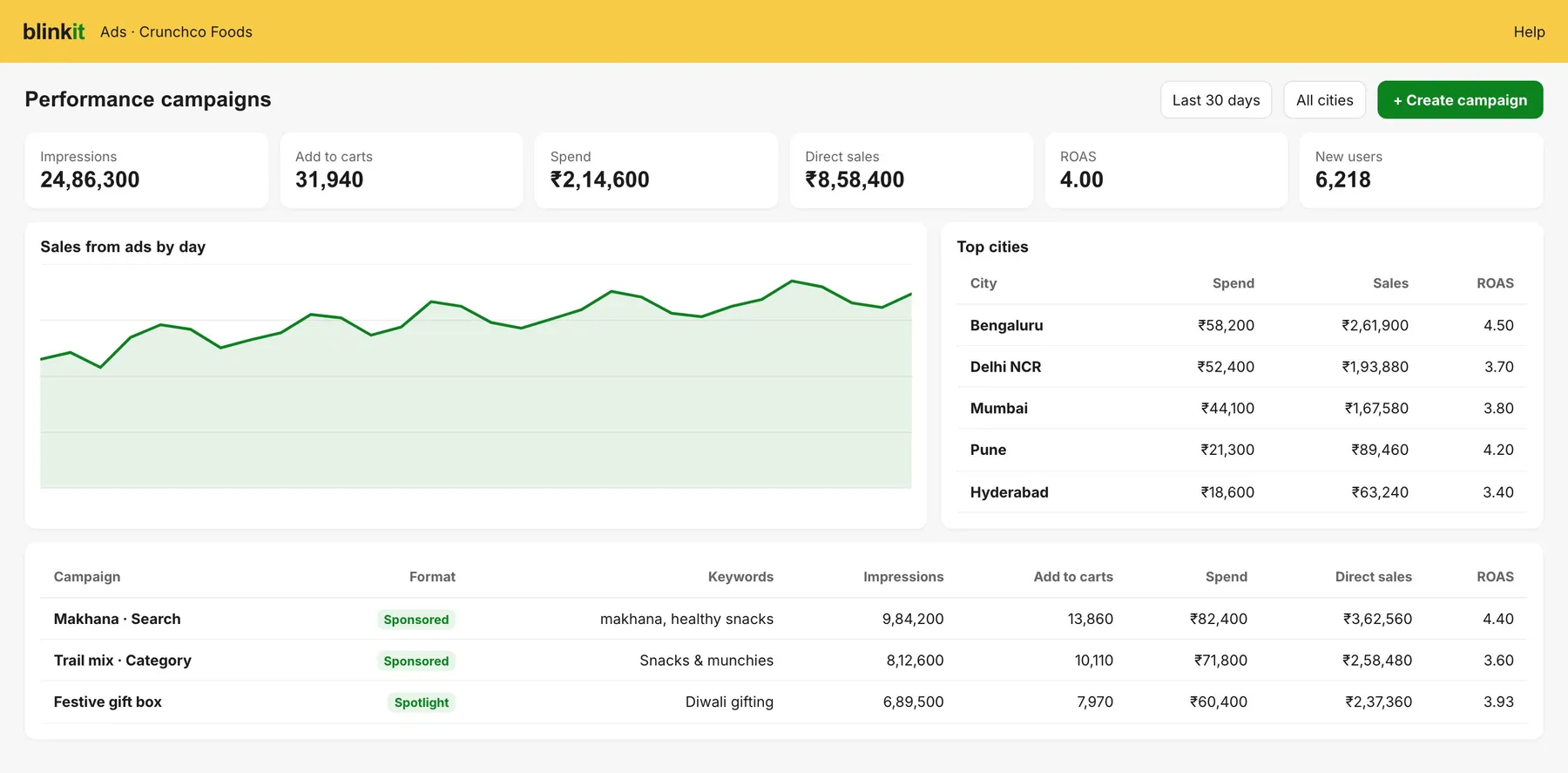
Blinkit Ads · Performance campaigns
Blinkit Ads performance campaigns with add to carts, direct sales, ROAS and city split

What we read here. We read ROAS city by city, and switch ads on only where the product is in stock in the dark stores. Open full size

Get the ROAS each of your Blinkit products needs.

What Blinkit’s ROAS counts, and what it leaves out

The dashboard is a good place to start and a poor place to stop. Three things make its ROAS look better than what you keep.

One month, two views

Blinkit showsNew buyers only
Units the ads claim1,000667
Ad sales, at MRP₹3,99,000₹2,66,100
Ad spend₹1,14,000₹1,14,000
ROAS3.5x2.3x

333 units came from brand searches that would have sold anyway. The face wash needs 2.9x.

The sale may be counted at MRP

Brands and agencies report that quick commerce dashboards value the sale at MRP. Blinkit hasn’t said either way. On the face wash, that reads 11% better than the price paid, and 18% better during a 15% offer.

Your brand name does a lot of the work

People searching your brand would find you without an ad. We split brand, category and competitor searches into their own campaigns and judge each one apart.

The last tap wins the whole basket

Tap one ad, add three more of your products later, and all of it can count as ad sales. We look at what new buyers did, not only the total.

None of this means Blinkit ads don’t work. It means the target is higher than it looks, and the products that truly grow aren’t always the ones at the top of the dashboard.

Ads that follow your stock, store by store, hour by hour

A Blinkit buyer only sees products stocked at the dark store that serves their street. With 2,751 stores and more opening every week, stock decides where an ad can work.

Sunscreen SPF 50 · Pune stores

  • Baner18 on the shelf
  • KothrudOut of stock
  • Viman Nagar11 on the shelf
  • WakadOut of stock
  • Aundh9 on the shelf
  • Hadapsar14 on the shelf
Ads paused in Kothrud and WakadBack on when Blinkit refills them

Ads only show where the nearest store has stock. Without a daily check, budget piles up around the full stores while the empty ones lose rank.

Stock first, every day

We read your stock by store each morning and keep spend away from shelves that are empty or nearly empty. When a store is refilled, the ads come back on.

New cities checked first

Blinkit added 308 stores last quarter, many in smaller cities. A city gets budget once your stock is there and the first orders show it sells.

The hours that sell

Sunscreen sells on summer mornings, makeup before a party, skincare late in the evening when the routine runs out. Budget moves to those hours.

Fill rate is an ad number too

Short deliveries empty Blinkit’s shelves, rank drops and ads cost more to win it back. We flag them to your supply team with the sales each one cost.

On most accounts, the quickest money we find in the first week is spend in areas where the product wasn’t on the shelf.

What changed on Blinkit since September 2025, and what we changed for you

Blinkit moves fast. These are the changes that matter for a beauty or skincare brand’s ads, newest first.

Updated November 2026

  1. Oct 2026

    2,751 stores, and smaller cities catching up

    What it means for your sales

    Blinkit added 308 stores in three months and aims for 3,500 by March 2027. New stores in smaller cities reach 1,000 orders a day about as fast as metro stores, with orders worth 85 to 90% as much.

    What we do

    We check which new stores carry your products before adding a city, and judge smaller cities on their own numbers.

  2. Oct 2026

    No Blinkit private labels, for now

    What it means for your sales

    Eternal’s CEO said Blinkit won’t compete with brands on its shelves, so it can “earn advertising revenue as the brands grow”.

    What we do

    Your ads won’t bid against Blinkit’s own brands. Expect more formats, and more brands in every auction.

  3. Sept 2026

    Quick commerce ROAS came under question

    What it means for your sales

    Agencies and brands reported that quick commerce dashboards may count ROAS at MRP. No platform has confirmed or denied it.

    What we do

    Every Blinkit ROAS is worked out again from your own sales data.

  4. Jul 2026

    Beauty became a big quick commerce category

    What it means for your sales

    Beauty and personal care on Blinkit, Zepto and Instamart neared US$1 billion a year in sales, up about 90%. Premium and masstige products took 59% of it, against 37% across the market.

    What we do

    Buyers here pay for better products, so we test your full-price and larger packs, not only the cheapest.

  5. Jun 2026

    More brands bidding for the same shelf

    What it means for your sales

    Blinkit, Zepto and Instamart were expected to earn about ₹4,900 crore from ads in 2026, up from about ₹3,000 crore in 2025.

    What we do

    Each product gets a cost ceiling from its margin, and bids stop there.

  6. Sept 2025

    Blinkit started buying your stock

    What it means for your sales

    Blinkit moved most brands to purchase orders and began setting the shelf price itself.

    What we do

    ROAS is worked out on the price Blinkit pays you, and sell-through is tracked by store.

Sources: Indian Startup News: Eternal Q2 FY27; Indian Retailer: Redseer beauty index; Storyboard18: quick commerce ad revenue; Stryder: Blinkit’s inventory model

The Blinkit ads we run, and the job each one does

We run every Blinkit format: the self-serve ones in Blinkit’s ad console, and the bigger ones booked with Blinkit’s ad team on your behalf. Each has a job, and an order to use them in.

Product Booster

Where it showsAt the top of search results and category pages with a Sponsored tag, plus spots near the cart

When we use itFrom day one. Brand, category and competitor searches run apart, because “face wash for oily skin” is a different fight from your brand name. Most of the budget.

Judged onROAS on the price Blinkit pays you, and new buyers from category searches

Listing Spotlight

Where it showsA swipeable row of your products with a link to your brand page

When we use itOnce your best products have rank. Good for shades, or a cleanser, serum and moisturiser sold as a routine.

Judged onAdd-to-carts across the range, and second products in the basket

Banners and category takeovers

Where it showsThe top of a category or search page, or the whole category page for a set time

When we use itFor launches and big weeks, once Product Booster pays on the same products. We run banners in the console and book takeovers with Blinkit’s team.

Judged onExtra sales against the weeks before and after

Brand Store

Where it showsYour own page inside the Blinkit app, which ads and banners can send buyers to

When we use itWhen you sell enough products for a page to help. We brief what goes on it and in what order, from what sells.

Judged onOrders and basket size from people who visit it

Order-screen ads, push and sampling

Where it showsThe screen buyers watch while their order is on its way, a push message, or a sample in the delivery bag

When we use itFor launches and trials. Booked by us with Blinkit’s ad team, aimed at buyers of your category or at carts that hold something your product goes with.

Judged onRepeat orders from people who saw or tried it, against similar buyers who didn’t

Meta ads that sell on Blinkit

Where it showsInstagram and Facebook ads showing your products from Blinkit’s catalogue, opening in Blinkit

When we use itRun by your Meta expert, only in cities where your stock is on the shelf.

Judged onBlinkit sales in those cities against cities without the ads

We don’t make banners, videos or brand page images. Your team, your designer or creators from our network make them, from a brief your expert writes using your Blinkit search data. A sachet of your serum in the bags of people who just bought a cleanser is the kind of match we look for.

Blinkit’s team offers you a package. Here is how we judge it

Blinkit’s category and ad teams will offer more than Product Booster: a takeover for Diwali, push, sampling, a banner pack. Some are worth it. We sit on your side of the table and judge each one in three steps.

1Before you say yes

We work out how many extra units the package must sell to pay for itself at your ROAS target. If that is more than the product has sold in its best week so far, we tell you.

2While it runs

Your Product Booster bids stay steady, so the package isn’t credited with sales your search ads would have won. Where we can, one similar city runs without it.

3After it ends

Sales are compared with the weeks before and after, and with that city. You get one page: buy again, buy smaller, or skip.

If your listing fee came back as ad credit, that money is already spent, and it expires. Use it on the products and cities most likely to sell. Spread thin across every product, it runs out before any of them gains rank.

Got a takeover or banner quote from Blinkit? Check it against your margins first.

Your Meta ads sell on Blinkit too

Plenty of people who see your Instagram ad for a serum never buy it on your website. They open Blinkit, type your brand name and have it in ten minutes. Meta’s Collaborative Ads let you send them there directly: your ad shows the product from Blinkit’s catalogue, and a tap opens it in Blinkit.

What usually happens

  • Your Meta team judges Instagram on website sales only, and cuts ads that were selling on Blinkit
  • Your Blinkit team sees brand searches climb and credits Product Booster
  • Nobody can say which of them earned the sale

What we do

  • Your Meta expert runs Collaborative Ads to Blinkit, only in cities where your stock is on the shelf
  • A few similar cities run without them, so the difference is plain
  • Your Blinkit expert tracks brand searches and sales in both, on the same weekly report

In Meta’s own case study, Britannia ran these ads across Blinkit, Swiggy and Zepto. Cost per purchase fell 45% in a quarter, and some campaigns reached 5x ROAS.

Want your Instagram ads to sell on Blinkit?

How we set up your Blinkit ads

In this order, from the first week.

  1. 1
    The ROAS each product needs

    Your purchase order margin, the offers you fund, the charges and your cost turn into the ROAS each product must clear. That number caps every bid.

  2. 2
    Ads off where they lose

    Products below their number, or spending where stock is thin, are paused or bid down until fixed.

  3. 3
    Your best products first

    Budget goes to the products with stock across your stores, good ratings and a margin that can carry ads.

  4. 4
    Brand, category and competitor kept apart

    Separate campaigns for your brand name, category searches and rival brands, each with its own budget and goal.

  5. 5
    Search terms found, then cut

    Blinkit suggests keywords with a typical bid. We keep the ones that sell, add negatives for the ones that don’t, and check every week.

  6. 6
    Cities and hours bid on their own

    Each city, and each part of the day, gets its own budget from where your stock is and when your products sell.

  7. 7
    Listing fixes briefed

    Your team gets the titles, image order and pack sizes to try, plus the stores that need stock. Your team makes the changes and handles purchase orders.

New on Blinkit? Listing-fee ad credits go to your three to five strongest products in your best city first, so they buy rank before the credit runs out.

What we need from you

  • Access to Blinkit’s ad dashboard, with us added as a user. The account stays in your name.
  • Your purchase order margin and any offers you fund, by product
  • Product cost by product
  • Stock by store, or the stock report Blinkit shares with you
  • Someone in your team who handles listings and purchase orders with Blinkit

The moments that move Blinkit, planned ahead

On Blinkit, beauty sells by the hour and by the occasion, not only on big sale days. We plan the stock with your team and the ads around the calendar, so a rush sells your stock and not a rival’s.

  1. 1
    Four weeks out

    Pick the products and cities, agree stock with your supply team, and agree any offer with your category manager. A deeper offer means each unit keeps less, so we redo the ROAS it needs.

  2. 2
    Two weeks out

    Steady Product Booster spend builds rank, so the product sits near the top before the rush. Any takeover or sampling offer is judged now.

  3. 3
    On the day

    Stock and bids are watched by the hour, and spend moves out of stores that run dry. Click prices can jump 40 to 50% in festive weeks, so each product’s cost ceiling holds.

  4. 4
    After

    Spend comes down in steps so rank holds, and the moment is judged on what it earned after Blinkit’s margin, the offer and the ads.

The Blinkit beauty calendar

Every dayEveningsWhen the routine runs out and people get ready to go out
FebValentine’s DayLip, fragrance and gift sets
MarHoliHair oils before, face washes after
Apr to JunSummerSunscreen, body mist, deodorant and oil control
Jul to SeptMonsoonFrizz care and sweat-proof makeup
AugRakhiGift sets
Oct to NovDiwaliGift kits and party makeup
Nov to FebWeddings and winterMakeup, moisturisers and lip balm
31 DecNew Year’s EveParty makeup, one of Blinkit’s busiest nights

Launches are planned like a moment of their own: sampling in the right carts, Listing Spotlight and Meta ads in the first cities together.

Planning for Diwali, the wedding season or a launch? Start from your own numbers.

What AI can do for your Blinkit ads, and what still needs an expert

Blinkit suggests keywords and bids, and AI tools can sort a search report in seconds. Our experts use AI as a co-pilot, and deciding what your brand needs stays with a person.

Suggested keywords

AI aloneBids on every suggestion at the suggested price, your brand name included.

Your expertKeeps the searches that win new buyers at a profit.

Stock

AI aloneCan’t see which dark stores are empty.

Your expertMoves spend away from empty shelves the same morning.

Dashboard ROAS

AI aloneTakes the number as it comes.

Your expertRebuilds it on the price Blinkit pays you, with brand searches split out.

Big weeks

AI aloneReacts once clicks have already got expensive.

Your expertBuilds rank two weeks ahead, while clicks cost less.

What skills and connectors don’t change

Shopify and other connectors can put your orders, costs and ad spend side by side for AI to read, and most public ads skills say they read your data and report back. Our experts use AI as a co-pilot. Deciding what to do, and answering for it, stays with a person.

Someone still has to say yes

AI aloneMeta makes a person approve every action an AI tool takes on your account, and Google’s own connector can’t change a budget or a bid.

Your expertReads each change against your margin and stock before saying yes.

It can be wrong and sound sure

AI aloneAsked only to summarise a document placed in front of it, Claude Opus 5.5 still got 9.9% of summaries wrong and Gemini 3.1 Pro 10.4% (Vectara leaderboard).

Your expertChecks every number against your store and courier data.

It guesses what you leave out

AI aloneIt does nothing until someone writes the prompt and explains the goal, and it fills every gap with an assumption.

Your expertAlready knows your margins, stock and sale dates.

It runs out, and the bill grows

AI aloneMost Claude plans cap use every five hours and every week, ChatGPT Plus every three hours, and extra use, bigger models and agent servers cost more.

Your expertStays on your account through the sale weeks, with no usage cap.

The model changes under you

AI aloneProviders retire older models, and the new one can answer the same prompt differently.

Your expertKeeps what works for your account, whichever tools change.

It can’t chase anyone

AI aloneIt can’t follow up with your agency, designer or warehouse, and nothing happens when it gets something wrong.

Your expertFollows up with your team, and we put your profit target in writing.

Where AI helps us

Your expert checks all of it first.

  • Search-term clean-up
  • Spotting stock-outs in exports
  • Banner brief drafts
  • Spotting spend jumps
  • Building the weekly report

See what a person finds in your Blinkit account.

Your Blinkit ads are run by a Blinkit expert

Blinkit has its own dashboard, buying model, ad team and calendar, so your account is run by an expert who works only on quick commerce, with at least three years on it and a capped number of brands. They check your account every day. Your direct competitors are never on the same expert’s desk.

If you run Zepto, Instamart or Meta with us, one person still leads your account and your weekly call. If your expert leaves, another quick commerce expert takes over from a written plan for your account.

What you see every week

  • Ad spend, ad sales and ROAS by product and city
  • ROAS on the price Blinkit pays you, against what each product needs
  • Brand, category and competitor searches, side by side
  • Stores where stock ran out, and the sales it cost
  • What changed, what’s next, and what didn’t work

Weekly report and call

ROAS by product and city, what changed and what’s next.

Stock alerts

Empty shelves flagged the day we see them, with the fix.

Monthly review

Results against the targets agreed in writing, and next month’s budget.

Slack or WhatsApp

Day-to-day questions answered by your Blinkit expert.

Custom reports brands ask for

  • Sell-through by store
  • Offer spend next to ad spend
  • New buyers by city
  • Blinkit vs Zepto vs Instamart
  • Quick commerce vs website profit

Your first 90 days on Blinkit

M.A.R.G.I.N.S., the method we use on every channel, applied to Blinkit.

Step 1 of 7 · Calibrate

Measure: we work out the ROAS each product needs

Your purchase order margin, offers, charges and cost give the number each product must clear, with brand searches split out as the baseline.

You get

A list of the ads losing money, and a bid limit for each product.

At the end of month 3 we review results against the targets agreed in writing and plan the next quarter and its big moments.

Who runs your Blinkit ads, compared

Who runs your Blinkit ads, compared
Typical agencyIn-house teamYour growth teamMobile First
Bids based onThe ROAS on the dashboardGut feel
Each product’s ROAS on the price Blinkit pays you
StockAds run until sales dropNoticed when the payout drops
Checked by store every day, spend moved the same morning
Brand searchesMixed in with the restMixed in with the rest
Run apart, so the real ROAS shows
Blinkit’s packagesBought when offeredBought when offered
Judged on your margins before and after
ReportingOne Blinkit reportA monthly spreadsheet
One weekly profit report across quick commerce and your website

Blinkit’s category and ad teams know the platform well. We work alongside them, and the call on where your money goes stays with you.

Compare your current setup in the free audit.

Questions to ask anyone running your Blinkit ads

An agency, Blinkit’s own team, your in-house executive or us. Each answer shows whether they grow what you keep or only what the dashboard shows.

  1. 1
    What ROAS does each of my products need on the price Blinkit pays us?

    If the answer mentions commission, it was worked out for the old model.

  2. 2
    How much of our ad spend goes on people searching our brand name?

    You want a number, and a reason it’s worth it.

  3. 3
    What happens to the ads when a store runs out?

    Spend there should stop the same day, not when sales drop.

  4. 4
    Is our ROAS counted at MRP or at the price paid?

    Ask to see both.

  5. 5
    How did you judge the last takeover or banner we bought?

    Against the weeks before and after, and a city without it, is the answer you want.

  6. 6
    Do our Meta and Blinkit teams see each other’s numbers?

    If not, one of them is taking credit for the other’s work.

60 seconds

Are we a great fit?

Five quick questions and an honest answer on screen. If we fit, book a call in the same place.

Talk to us about your Blinkit ads

Tell us about your brand. We read your accounts before the call, so it is about your numbers.

  • Free growth audit, yours to keep
  • ROAS and profit read for every channel
  • WhatsApp reply within 48 hours

Questions about Blinkit ads

Which Blinkit ad types do you run?

All of them. In Blinkit’s ad console we run Product Booster in search and categories, Listing Spotlight and banners, with bids by city and hour. With Blinkit’s ad team we plan and book takeovers, order-screen ads, push and sampling. We brief your Brand Store, and your Meta expert runs Collaborative Ads that send Instagram and Facebook buyers to Blinkit.

How do Blinkit ads work now that Blinkit buys our stock?

Since September 2025 Blinkit buys most brands’ stock on purchase orders and sets the shelf price. Your ads now sell stock Blinkit already owns, and how fast it sells shapes the next order. So we work out ROAS on the price Blinkit pays you, not the shelf price, and track sell-through by store.

What is a good ROAS on Blinkit?

There’s no single good number. It depends on each product’s MRP, Blinkit’s margin, the offer you fund and your cost. A ₹399 face wash at a 20% margin, with half a 10% offer funded by the brand, needs about 2.9x on MRP to break even, and more once brand searches come out. We work it out for every product.

How much do Blinkit ads cost?

Product Booster is paid per click and you set the budget, so there is no fixed minimum. Blinkit publishes no rate card or click prices. They depend on the category, the city and the hour, and rise in festive weeks. Takeovers, order-screen ads, push and sampling are quoted by Blinkit’s ad team. Budgets are set per product and city after the audit.

What is the Blinkit listing fee?

Brands report a fee per product, per state, returned as ad credit that expires after about a year. Terms differ by brand, so check yours with your category manager. If you have the credit, we spend it on the products and cities most likely to sell before it runs out.

Is Blinkit’s ROAS counted at MRP?

Brands and agencies report that quick commerce dashboards count the sale at MRP. Blinkit hasn’t said either way. We rebuild ROAS from your own sales data, on the price paid and on the price Blinkit pays you, so it doesn’t matter which one the dashboard uses.

Why are our ads spending where we’re out of stock?

Stock changes store by store, many times a day, and budgets are often set by city. We read stock by store every day, keep spend away from empty shelves and flag short deliveries to your supply team.

Can you target by city and time of day on Blinkit?

Yes. Blinkit lets brands target by city, by type of shopper and by time of day. We plan each one around where your stock is and when your products sell.

Should we start with banners or Product Booster?

Product Booster, on your best products, in the cities where your stock is strongest. Banners and takeovers come once those products pay and have rank, and we test them against a city without them.

Can our Instagram ads send buyers to Blinkit?

Yes, through Meta’s Collaborative Ads, which use Blinkit’s catalogue so a tap opens your product in Blinkit. Your Meta expert runs them only in cities where your stock is, and we compare Blinkit sales in cities with and without the ads, so you know what they added.

Does Blinkit work for skincare and beauty brands?

Often very well. Beauty is one of the fastest-growing categories on quick commerce, and buyers there pay for premium products more than in the market overall. Products people run out of, like face wash, sunscreen, lip care and deodorant, sell best. We start with your top products in the cities where your stock is strongest.

Do you manage our Blinkit listings, onboarding or supply?

No. We brief what holds the ads back: titles, images, pack sizes and which stores need stock. Your team makes the changes and handles purchase orders with Blinkit. We don’t run onboarding, catalogue uploads or deliveries.

Can you run Zepto and Instamart too?

Yes. All three sit on one weekly report, so budget goes to the app where each product earns most.

Can ChatGPT or Claude run our Blinkit ads?

They can do more than most people think: read your accounts, sort reports and draft campaigns, and our experts use them for that. What they can’t do is decide, or answer for a wrong call. They can be wrong in a sure tone, they guess at whatever you leave out, and their plans cap how much you can use them. Your expert approves every change against your margin and stock.

What access do you need, and do we keep the account?

Read-only access to Blinkit’s ad dashboard for the audit. To run ads, we are added as a user on your account. The account and its data stay in your name.

Before you go: is your Blinkit ROAS counted on what you keep?

Our free growth audit works out the ROAS your top products need on the price Blinkit pays you, and shows which ads spend on brand searches or empty shelves. Your Blinkit expert reads your account within 48 hours, and the audit is yours to keep.