





Amazon ads agency for D2C brands in India: Amazon ads that grow the sales you keep
Your Amazon expert works out how much each product can spend to win an order, then bids within it every day. Each week you see ACoS next to what you keep after Amazon’s fees and returns, and whether your total Amazon sales are growing or only the ones ads claim.
- One Amazon expert on your account, 3+ years on Amazon
- Bids checked every day against Buy Box, stock and rating
- Amazon on the same weekly profit report as your website
 Amazon campaignsWeek 43
Brands our marketers have worked with











Why Amazon ads stop paying
ACoS is counted before Amazon takes its share
The console divides ad spend by the order value. Referral, closing and shipping fees, returns and your product cost come out later, so a 30% ACoS can lose money on one product and make good money on another.
Ads buy orders you’d have got anyway
Bids on your own brand name, and on products already ranking first, bring in sales that would have come free. Ad sales climb, total sales stay flat, and TACoS creeps up month after month.
Ads go quiet the day the Buy Box goes
If another seller undercuts you on your own listing, or stock runs out in a fulfilment centre, Sponsored Products stop showing. Nobody notices till the weekly report, and by then rank has slipped.
Sale days spend the most and earn the least
Bids go up on Prime Day itself, when clicks cost the most, on products that never built rank in the weeks before. Once the sale ends, rank falls back and sales follow.
Find out which of your products lose money on ads.
Your Amazon expert reads your account and sends the report in 48 hours.
Get my free growth auditSwipe for more
How much ACoS can each product afford?
Every product has a break-even ACoS: the share of its price it can spend on ads before the order loses money. Here is one ₹1,299 kurta sold through Easy Ship, with every cost Amazon India takes.
- 1GST on the sale
Kurtas up to ₹2,500 carry 5% GST, so ₹62 of the price was never yours.
- 2Amazon’s fees
A 16.5% referral fee on ethnic wear above ₹1,000, a ₹79 closing fee on Easy Ship and ₹55 to ship a parcel under 500 g.
- 3Product cost and packing
What the kurta cost you to make, pack and send to the dispatch point.
- 4Returns
About one in seven fashion orders comes back. Spread across every order, that is about ₹80 each.
- 5The break-even ACoS
What is left, as a share of the price. This number becomes the bid ceiling for that product.
One kurta, one order
| Taken | Left | |
|---|---|---|
| The buyer pays | ₹1,299 | |
| GST on the sale, 5% | −₹62 | ₹1,237 |
| Referral fee, 16.5% | −₹214 | ₹1,023 |
| Closing fee, Easy Ship | −₹79 | ₹944 |
| Shipping, under 500 g | −₹55 | ₹889 |
| Product cost and packing | −₹520 | ₹369 |
| Returns, spread per order | −₹80 | ₹289 |
| Break-even ACoS | 22% |
- At 30% ACoS, the ad costs ₹390−₹101 an order
- At 20% ACoS, the ad costs ₹260+₹29 an order
Amazon also adds 18% GST on its fees (₹63 on this order) and on your ad spend, and holds back 0.5% TCS and 0.1% TDS from each payout. GST-registered sellers claim these back, so we show them in your report but leave them out of the break-even.
The console shows this kurta at 30% ACoS, a 3.3 ROAS, and most teams would leave it running. It loses ₹101 on every order the ads bring in. Your expert works out this number for every product you sell and rechecks it each time Amazon changes its fees.
The two Amazon screens we read every day
Seller Central shows what you sold. The ad console shows what ads claim. We read them side by side.
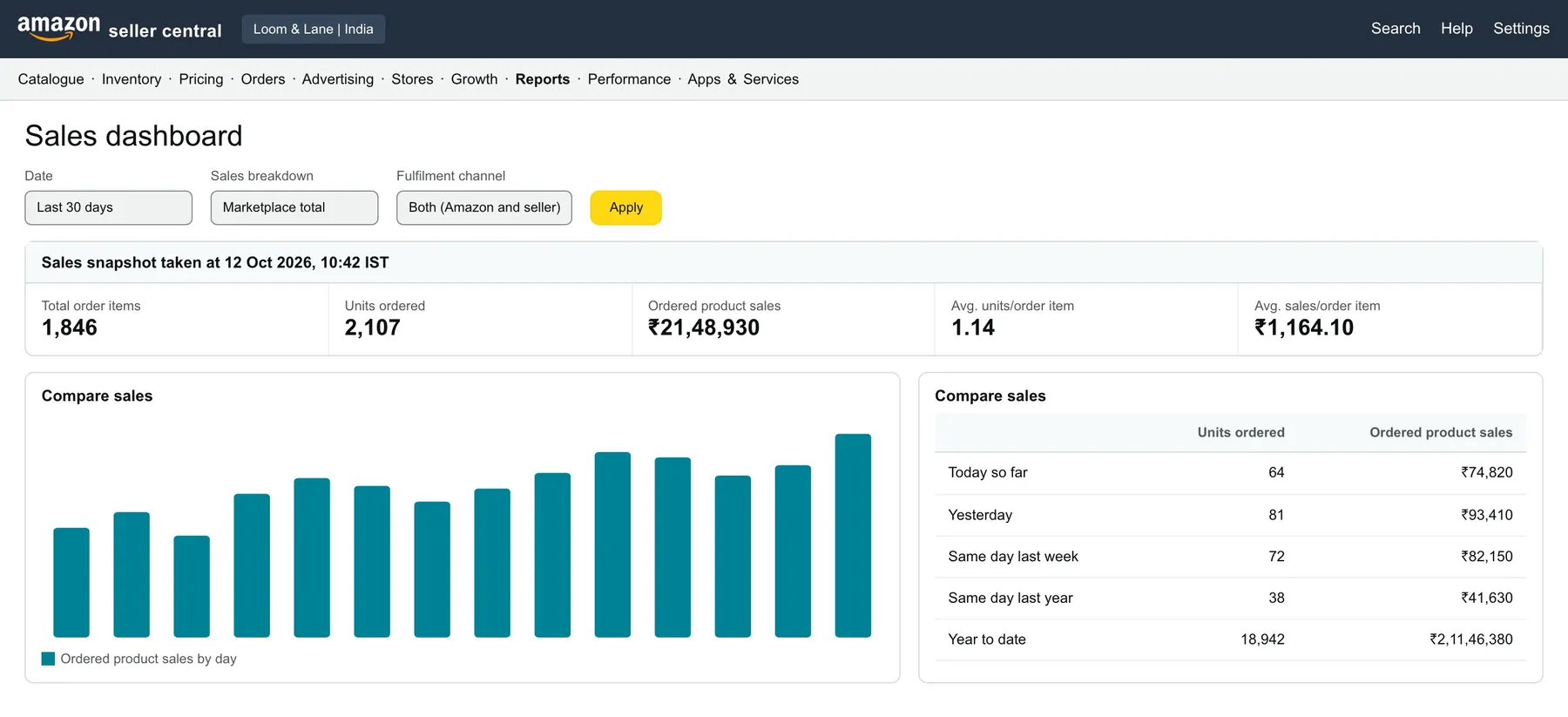
What we read here. Ordered product sales count orders before returns and fees. We net off referral fees, shipping and returns before calling a product profitable. Open full size
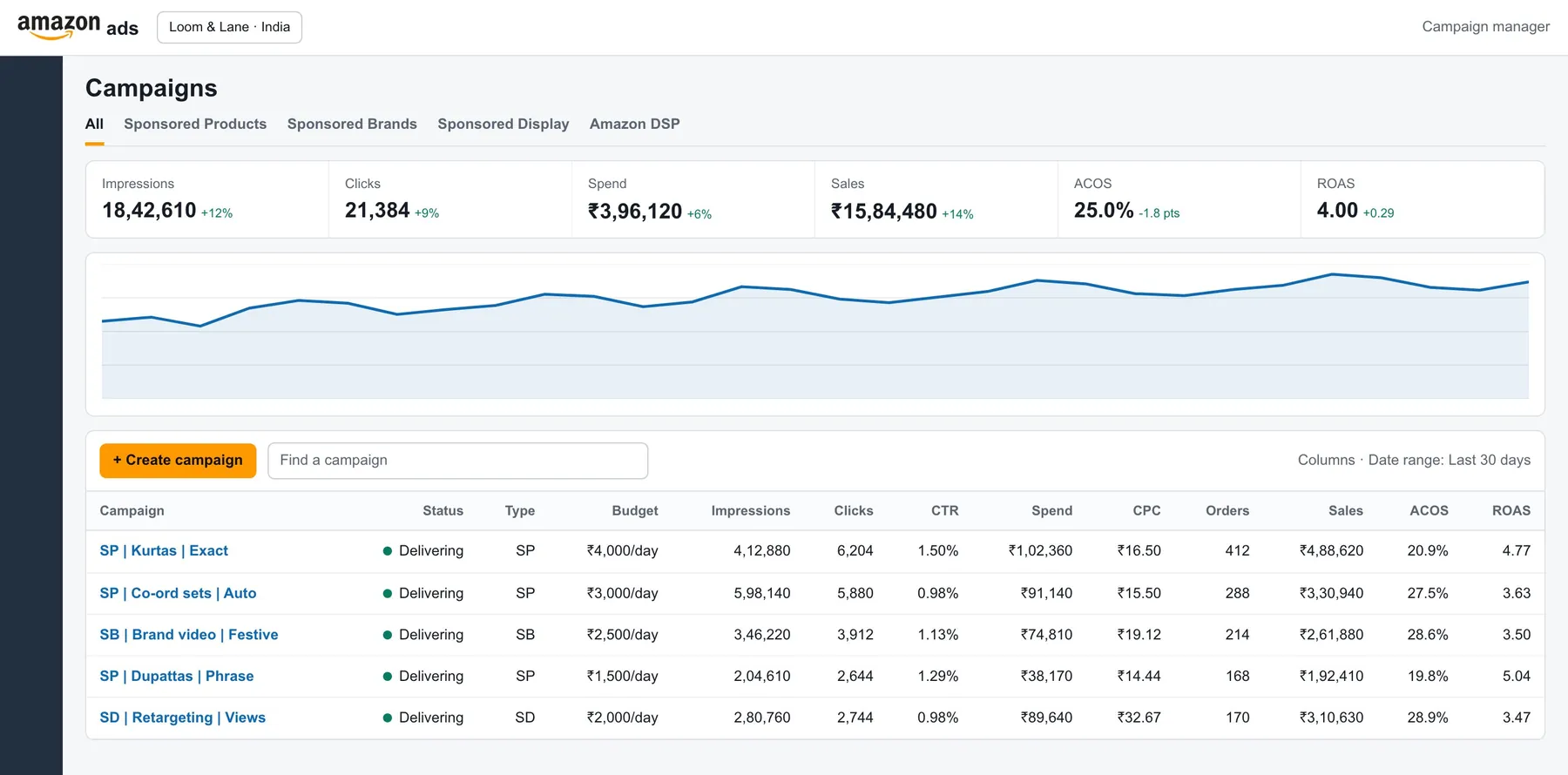
What we read here. ACOS and ROAS here use ad-attributed sales only. We read them next to TACoS and margin after fees, so ads are judged on the whole business. Open full size
Get the break-even ACoS for every product you sell.
Are ads growing your Amazon sales, or buying them?
An ad sale on Amazon does two jobs. It earns the order, and it tells Amazon your product sells, which lifts where it shows up without ads. When that works, you need fewer ads over time. When it doesn’t, you pay for the same orders forever.
Ads buying salesTACoS up from 8% to 13%
Ads growing salesTACoS down from 8% to 6%
TACoS shows which one is happening
ACoS is ad spend against the sales ads claim. TACoS is ad spend against all your Amazon sales. If spend rises and TACoS falls, ads are pulling organic sales up with them. If TACoS keeps rising, ads are replacing sales you used to get free.
Your brand name is kept apart
People searching your brand were already on their way to you. Those searches run in their own campaigns and are reported on their own, so they can’t make the rest of the account look better than it is.
Your share of each top search, every week
Brand Analytics shows what share of clicks and purchases your products won on each search. We pick the 10 to 20 searches that matter most and report your share weekly, so you can watch rank being built.
Swipe for more
What changed on Amazon in 2026, and what we changed for you
Fees, ad formats and Amazon’s own AI tools all moved this year. These are the changes that matter for a D2C brand, newest first.
Updated November 2026
Oct 2026
Prime Video ads you can shop from
What it means for your salesInteractive and pause ads on Prime Video India let viewers add your product to the cart from the TV. Amazon made them free to add over the festive season.
What we doUsed for launches and sale weeks, once your search ads already pay back.
Sept 2026
Amazon Ads Agent and Full-Funnel Campaigns
What it means for your salesAmazon is bringing the ad console and DSP into one place with an AI assistant, plus campaigns where its AI picks the channel mix. Rolling out over the coming months.
What we doTried on one campaign at a time, with a spend cap set from your margin.
Sept 2026
Closing fees went up
What it means for your sales₹1 more on products up to ₹500 and ₹3 more above it. Small per order, but it lowers the break-even ACoS on low-priced products.
What we doBreak-even rechecked for every product, and bid ceilings moved.
Jul 2026
Prime Day, and MX Player joined Prime Video
What it means for your salesPrime Day India ran 4 to 6 July. Streaming ads on Amazon now reach one combined audience.
What we doSale plans now start six weeks out, with streaming kept for brands already scaling.
Mar 2026
Zero referral fee under ₹1,000
What it means for your salesAmazon dropped the referral fee on products under ₹1,000 and cut Easy Ship fees under ₹300. Those products can now afford a higher ACoS.
What we doBid ceilings raised product by product, where the margin allows.
Mar 2026
Fixed-price top of search for your brand
What it means for your salesAt its first India event, Amazon brought Sponsored Brands reserve share of voice, homepage takeovers and Creative Agent, a free AI tool for ad videos and images.
What we doBought only when rivals are bidding on your brand name. Creative Agent drafts are checked by your team before use.
Feb 2026
AI tools can plug into Amazon Ads
What it means for your salesAmazon opened an MCP server, so outside AI tools can read and change your campaigns.
What we doUsed for reports. Every change that moves money is made by your expert.
Swipe for more
Sources: Amazon: zero referral fee; Amazon: seller fees; Amazon Ads: Connected Worlds India; Amazon Ads: unBoxed 2026; Prime Video India interactive ads; Amazon Ads MCP server
The Amazon ads we run, and the job each one does
Each format shows in a different place and needs something different from you. We start where buyers are already searching and add the rest when the numbers support it.
Sponsored Products
Where it showsSearch results and other product pages
What it needsYou must hold the Buy Box. Open to every seller.
From day one, split into brand, category and competitor campaigns. Usually 70% or more of the budget.
Judged onACoS against each product’s break-even, and TACoS
Sponsored Brands
Where it showsTop of search with your logo, video in the results, or a link to your Brand Store
What it needsBrand Registry, and a Brand Store for the store version
Once you have three or more products worth showing together. Video often wins the cheapest clicks in fashion and beauty.
Judged onNew-to-brand orders and your share of top searches
Sponsored Display
Where it showsProduct pages, and on and off Amazon for people who viewed your products
What it needsBrand Registry
To bring back people who viewed and didn’t buy, and on rival pages where your rating and price win.
Judged onOrders from returning viewers, with view-only sales reported apart
Prime Video and Sponsored TV
Where it showsBefore and during shows, with interactive and pause ads
What it needsA video your team or creators make, cut for TV. Sponsored TV has no minimum spend.
For launches and sale events, once search ads pay back. Amazon says 78% of its Prime Video viewers in India shop on Amazon.in every month.
Judged onBranded searches and product page visits, then sales in the weeks after
Amazon DSP
Where it showsDisplay and video across Amazon, its apps and other websites
What it needsA bigger budget than sponsored ads, and enough Amazon sales to build audiences from
For brands already growing on sponsored ads that want new buyers at scale, or repeat orders from past buyers.
Judged onNew-to-brand sales and repeat purchases
Swipe for more
We don’t make ad videos, Brand Store images or A+ content. Your team, your designer or creators from our network make them, from a brief your expert writes using your search and review data.
Five things that decide whether an Amazon ad pays
An Amazon ad sends the buyer to your product page. If the page loses them, you’ve paid for the click and lost the order. Your Amazon expert checks these five every day.
1The Buy Box
We checkWhether your offer is the one shown on your own listing.
When it failsSponsored Products stop showing, and any other ad sends the buyer to another seller.
We flag it the same day with the seller and price that took it. Pricing and seller action stay with you.
2Stock where buyers are
We checkStock by product and size, and in which fulfilment centres.
When it failsAds stop, or delivery slips to four or five days and buyers pick the one that arrives tomorrow.
We pause or lower bids the same day and tell your team what to send in, and where.
3Ratings and reviews
We checkStar rating, review count and what recent reviews complain about.
When it failsA buyer picks the 4.3-star kurta over your 3.8 however good the ad, so every click costs more.
Each month we send you the top complaints, so the product, sizing or listing can change.
4The listing
We checkTitle, images, video, A+ content, and whether the words buyers search are on the page.
When it failsThe product shows for the wrong searches and doesn’t sell on the right ones.
We brief the words and the image order; your team or designer makes them; we check before they go live.
5Price
We checkYour price against close rivals and against your own website.
When it failsBuyers compare and leave, or a lower website price makes Amazon show your product less.
We flag gaps every week. Price decisions stay with you.
Swipe for more
We don’t run catalogue uploads or account setup. We fix what holds your ads back, and tell you when the problem sits outside the ads.
See where your listings leak before you raise bids.
Seller or vendor, FBA or Easy Ship: what your setup changes
How you sell on Amazon changes how ads count sales, who sets the price and how fast buyers get the parcel. We plan the account around it.
Seller Central
You set the price and carry the Buy Box risk. Sponsored Products count a sale up to 7 days after the click, so we watch price and Buy Box daily.
Vendor Central
Amazon buys your stock and sets the price. Ads count sales up to 14 days after the click, so results look higher. We track Amazon’s purchase orders, because ads stop working when they stop.
Fulfilled by Amazon
The Prime badge and fast delivery usually lift sales and help win the Buy Box. We watch stock in each fulfilment centre, since running out in one region slows delivery there.
Easy Ship or self-ship
You control stock and dispatch, but delivery can take longer and the Prime badge may be missing. Bids go lower where slow delivery costs orders, and we tell you which products would earn more on FBA.
Swipe for more
Selling both ways? Seller and vendor sales are reported apart, because the same ACoS means different things in each.
How we set up your Amazon ads
In this order, from the first week.
- 1A break-even ACoS for every product
Your cost and Amazon’s fees for each product turn into the most it can spend per order. That becomes its bid ceiling.
- 2Ads off where they lose
Products under 3.5 stars, out of stock or without the Buy Box are paused or bid down until they’re fixed.
- 3Brand, category and competitor kept apart
Separate campaigns for your brand name, category searches and rival products, each with its own budget and goal.
- 4Search terms found, then scaled
Auto and broad campaigns find what buyers type. Terms that sell move to exact match with their own bids, and terms that don’t are added as negatives every week.
- 5Placements bid on their own
Top of search, the rest of search and product pages sell very differently, so each gets its own bid adjustment.
- 6Rival pages picked with care
Your ads go on competitor pages only where your rating, price and delivery win the side-by-side.
- 7Brand Registry tools switched on
Sponsored Brands, a Brand Store, A+ content briefs and search share tracking, once Brand Registry is in place.
What we need from you
- Access to Seller Central or Vendor Central, and your Amazon Ads account, with us added as a user. The accounts stay in your name.
- Brand Registry details, if you have them
- Product cost for each product, so we can work out its break-even
- Stock plans and inbound shipments
- Someone in your team who can update listings and images from our brief
Prime Day and Great Indian Festival, planned six weeks ahead
Rank on sale day is earned in the weeks before it. Brands that only raise bids on the day pay the most for clicks and lose the rank when the sale ends.
- 1Six weeks out
Pick the products to push from margin and stock, and agree deals, coupons and Prime-only prices with you. A deal lowers the price, so we redo the break-even at the sale price.
- 2Four weeks out
Raise ads on those products to build rank and reviews while clicks are cheaper, and check stock in fulfilment centres will last the sale.
- 3Sale days
Bids and budgets checked several times a day. Money moves to what is selling, and ads pause the hour a product runs out.
- 4The two weeks after
Spend comes down in steps so rank doesn’t drop off a cliff. You get a report of what the sale earned after deals, fees and returns, and how many buyers were new.
The Amazon sale calendar
| Jan | Republic Day saleAmazon-wide deals |
|---|---|
| Jul | Prime DayPrime members only, 4 to 6 July in 2026 |
| Aug | Freedom saleAmazon-wide deals |
| Sept to Oct | Great Indian FestivalThe biggest weeks of the year |
| Oct to Nov | Diwali giftingGift sets, jewellery, home and beauty |
| Any month | Your own launchesPlanned like a sale |
Dates move every year, so the plan starts from Amazon’s announcement.
Plan your next Amazon sale from your own numbers.
What AI can do for your Amazon ads, and what still needs an expert
Amazon already bids with AI, and this year it added Ads Agent and Creative Agent. Our experts use AI as a co-pilot, and deciding what your brand needs stays with a person.
Bids
AI aloneDynamic bids chase the order value the console counts.
Your expertCaps every product at its own break-even ACoS.
Your brand name
AI aloneSpends happily on your brand searches, where you’d have sold anyway.
Your expertKeeps brand in its own campaign, judged apart from growth.
Buy Box and stock
AI aloneDoesn’t know another seller took your listing this morning.
Your expertFlags it the same day and moves budget to products that can sell.
Sale events
AI aloneReacts after clicks have already got expensive.
Your expertBuilds rank in the weeks before, while clicks cost less.
Swipe for more
What skills and connectors don’t change
Shopify and other connectors can put your orders, costs and ad spend side by side for AI to read, and most public ads skills say they read your data and report back. Our experts use AI as a co-pilot. Deciding what to do, and answering for it, stays with a person.
Someone still has to say yes
AI aloneMeta makes a person approve every action an AI tool takes on your account, and Google’s own connector can’t change a budget or a bid.
Your expertReads each change against your margin and stock before saying yes.
It can be wrong and sound sure
AI aloneAsked only to summarise a document placed in front of it, Claude Opus 5.5 still got 9.9% of summaries wrong and Gemini 3.1 Pro 10.4% (Vectara leaderboard).
Your expertChecks every number against your store and courier data.
It guesses what you leave out
AI aloneIt does nothing until someone writes the prompt and explains the goal, and it fills every gap with an assumption.
Your expertAlready knows your margins, stock and sale dates.
It runs out, and the bill grows
AI aloneMost Claude plans cap use every five hours and every week, ChatGPT Plus every three hours, and extra use, bigger models and agent servers cost more.
Your expertStays on your account through the sale weeks, with no usage cap.
The model changes under you
AI aloneProviders retire older models, and the new one can answer the same prompt differently.
Your expertKeeps what works for your account, whichever tools change.
It can’t chase anyone
AI aloneIt can’t follow up with your agency, designer or warehouse, and nothing happens when it gets something wrong.
Your expertFollows up with your team, and we put your profit target in writing.
Where AI helps us
Your expert checks all of it first.
- Search-term clean-up
- Sorting review complaints
- Spotting spend jumps
- Title and bullet drafts
- Building the weekly report
See what Amazon’s AI is doing with your budget.
Your Amazon ads are run by an Amazon expert
Amazon has its own rules, tools and sale calendar, so your account is run by an expert who works only on Amazon, with at least three years on it and a capped number of brands. They check your account every day. Your direct competitors are never on the same expert’s desk.
If you run other platforms with us, one person still leads your account and your weekly call. If your expert leaves, another Amazon expert takes over from a written plan for your account.
What you see every week
- Ad spend, ad sales, ACoS and TACoS, by product
- Each product’s ACoS against its break-even
- Brand and non-brand results, side by side
- Your share of clicks and purchases on top searches
- Buy Box, stock and rating problems, and what was done
- What changed, what’s next, and what didn’t work
| A | B | C | D | E | F | |
|---|---|---|---|---|---|---|
| 1 | Campaign | Spend | Revenue | ROAS | Contribution margin | vs last week |
| 2 | Category search | ₹1,20,000 | ₹4,92,000 | 4.10 | ₹48,600 | +₹6,200 |
| 3 | Sponsored Brands video | ₹60,000 | ₹2,16,000 | 3.60 | ₹19,200 | +₹3,100 |
| 4 | Your brand name | ₹20,000 | ₹1,88,000 | 9.40 | ₹11,800 | +₹900 |
| 5 | Competitor pages | ₹40,000 | ₹1,33,200 | 3.33 | -₹10,100 | -₹4,200 |
| 6 | Total | ₹2,40,000 | ₹10,29,200 | 4.29 | ₹69,500 | +₹6,000 |
Weekly report and call
ACoS, TACoS and margin by product, what changed and what’s next.
Buy Box and stock alerts
Flagged the day we see them, with the fix.
Monthly review
Results against the targets agreed in writing, and next month’s budget.
Slack or WhatsApp
Day-to-day questions answered by your Amazon expert.
Swipe for more
Custom reports brands ask for
- Margin by product and size
- New-to-brand buyers
- Seller vs vendor
- Sale results after deals
- Amazon vs website profit
Your first 90 days on Amazon
M.A.R.G.I.N.S., the method we use on every channel, applied to Amazon.
Step 1 of 7 · Calibrate
Measure: we work out what every product can spend
A break-even ACoS for every product from your cost and Amazon’s fees, brand and non-brand split, and TACoS and search share set as the baseline.
A list of the ads losing money, and a bid ceiling for each product.
Step 2 of 7 · Calibrate
Attention: we stop the biggest leak first
Usually ads on products without the Buy Box or stock, brand searches counted as growth, or rival pages where your product loses the comparison.
Wasted spend cut in the first fortnight.
Step 3 of 7 · Test and scale
Run tests: we test searches, placements and formats
Search terms, placement bids and Sponsored Brands video are tested one at a time, with listing fixes briefed to your team.
Winners picked on margin, not on ACoS alone.
Step 4 of 7 · Test and scale
Grow the winners: we scale what makes money
Spend rises in steps on products under their break-even, while TACoS and search share are watched so ads grow total sales.
More orders at the margin you agreed.
Step 5 of 7 · Automate and lead
Invite buyers back: we bring viewers and past buyers back
Sponsored Display for viewers who didn’t buy, and DSP for repeat orders once you’re scaling.
Cheaper second orders on your hero products.
Step 6 of 7 · Automate and lead
Never stop improving: we plan the next sale
Products, stock, deals and budget for the next Prime Day or festival sale, set six weeks ahead.
Rank built before clicks get expensive.
Step 7 of 7 · Automate and lead
Systemise: we set alerts that never sleep
Alerts for lost Buy Boxes, stock-outs, rating drops and spend jumps run on their own.
Problems caught and fixed the same day.
At the end of month 3 we review results against the targets agreed in writing and plan the next quarter and its sales.
Who runs your Amazon ads, compared
| Typical agency | Amazon account manager | In-house team | Your growth teamMobile First | |
|---|---|---|---|---|
| Works for | You, often on Amazon alone | Amazon, judged on what you spend there | You | You, across Amazon, other platforms and your website |
| Bids based on | One ACoS target for the whole account | Spend and Amazon’s own targets | Gut feel | Each product’s break-even ACoS |
| Brand searches | Mixed in with the rest | Encouraged | Mixed in | Run and reported apart |
| Buy Box and stock | Noticed when sales drop | Not their job | When someone checks | Checked every day, ads moved the same day |
| Reporting | ACoS and ROAS | Amazon’s own dashboard | A monthly spreadsheet | ACoS, TACoS and margin by product, on one weekly profit report |
Swipe for more
Your Amazon account manager knows the platform and brings early access to new formats. We work with them, and the call on where your money goes stays with you.
Compare your current setup in the free audit.
Questions to ask any Amazon ads agency before you sign
Ask us too. Each answer shows whether the team will grow what you keep or only what the console shows.
- 1What is the break-even ACoS for each of my products?
One ACoS target for the whole account means some products are losing money.
- 2Do you report brand and non-brand apart?
Brand searches always look good, and mixed in they hide weak campaigns.
- 3How will I know ads are lifting organic sales?
Ask for TACoS and your share of top searches, every week.
- 4What happens when I lose the Buy Box or run out of stock?
Someone should spot it the same day, not at the monthly review.
- 5When do you start planning for Prime Day?
Six weeks out is the answer you want.
- 6Who makes the videos and A+ content, and who briefs them?
Ask who decides what goes in them, and who checks them before they go live.
Related tools and services
Swipe for more
Are we a great fit?
Five quick questions and an honest answer on screen. If we fit, book a call in the same place.
Talk to us about your Amazon ads
Tell us about your brand. We read your accounts before the call, so it is about your numbers.
- Free growth audit, yours to keep
- ROAS and profit read for every channel
- WhatsApp reply within 48 hours
Questions about Amazon ads
Which Amazon ad types do you run?
Sponsored Products, Sponsored Brands (including video), Sponsored Display, Prime Video and Sponsored TV ads, and Amazon DSP for brands already scaling on sponsored ads.
What is the difference between ACoS and TACoS?
ACoS is ad spend divided by the sales your ads claim. TACoS is ad spend divided by all your Amazon sales, with or without ads. If ACoS holds steady while TACoS keeps rising, ads are buying orders you would have got anyway.
What is a good ACoS on Amazon India?
There’s no single good number. It depends on each product’s margin after Amazon’s fees, returns and product cost. A product with a 22% break-even loses money at 30% ACoS, while one with a 40% break-even is still profitable there. We work it out for every product.
How much do Amazon ads cost?
Sponsored ads are paid per click and have no minimum spend. The cost per click depends on your category, the search and the season, and rises during sales. DSP needs a bigger budget, so it suits brands already growing on sponsored ads.
What fees does Amazon India take on each order?
A referral fee (a share of the price that changes by category, and zero under ₹1,000 since March 2026), a closing fee, a shipping or weight handling fee, and 18% GST on those fees. Amazon also holds back 0.5% TCS and 0.1% TDS from payouts, which GST-registered sellers claim back.
Do I need Brand Registry to run Amazon ads?
Not for Sponsored Products. You need it for Sponsored Brands, Sponsored Display, A+ content, a Brand Store and Brand Analytics. In India it needs a trademark registered or applied for with IP India, and Amazon approves each brand.
Why did my Amazon ads stop showing?
Usually a lost Buy Box, stock running out, a listing problem or a budget cap. Sponsored Products only show when your offer is the one buyers see on the listing. We check all four every day.
Can Amazon ads improve our organic rank?
Yes, when ads bring sales on searches you want to rank for and the listing sells well. We track your share of clicks and purchases on top searches, and TACoS, so you can see whether it’s happening.
How do you plan for Prime Day and Great Indian Festival?
We pick the products about six weeks ahead, build rank in the weeks before, check bids several times a day during the sale and bring spend down in steps afterwards. You get a report of what the sale earned after deals, fees and returns.
Do you work with sellers and vendors?
Yes. We run Seller Central, Vendor Central or both, and report them apart because ads count sales differently in each.
Do you manage our listings and catalogue?
We fix what holds the ads back: search words, titles, image order and A+ content briefs. Your team or designer makes the images and videos from our brief. We don’t run catalogue uploads or account setup.
Can ChatGPT or Claude run our Amazon ads?
They can do more than most people think: read your accounts, sort reports and draft campaigns, and our experts use them for that. What they can’t do is decide, or answer for a wrong call. They can be wrong in a sure tone, they guess at whatever you leave out, and their plans cap how much you can use them. Your expert approves every change against your margin and stock.
Do you work with our Amazon account manager?
Yes. We share our plan with them and use their insights and early access to new formats. Decisions about your budget stay with you.
Can you run Amazon alone?
Yes. Many brands start with Amazon and add Flipkart, Myntra, quick commerce or Meta once it pays.
Is there a minimum spend for Amazon ads?
Sponsored ads have no minimum spend. Amazon DSP needs a much larger budget, so it suits brands already scaling on sponsored ads.
Can you improve our organic rank?
Ads that sell well can lift organic rank over time. We track TACoS to see whether ads are growing total sales or only buying them.
How do you report Amazon ads?
On margin after referral fees, shipping and returns, in the same weekly report as your website and other channels.